
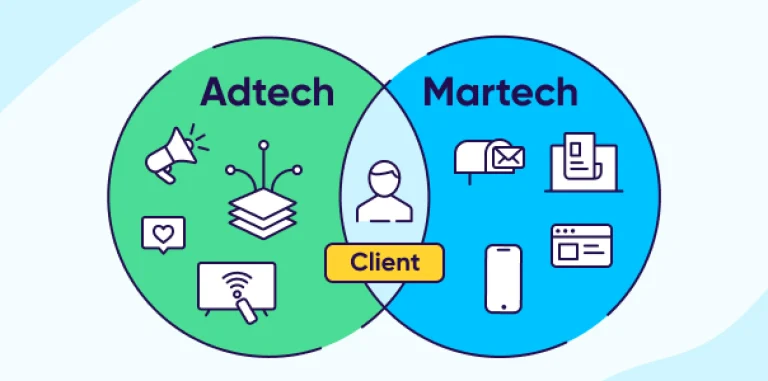
In recent decades, digital marketing has evolved exponentially. What started as simple email campaigns and banner ads has evolved into complex technological ecosystems designed to manage every point of contact with the customer. In this technological landscape, two terms have emerged as key pillars: MarTech (Marketing Technology) and AdTech (Advertising Technology). Traditionally, these two disciplines operated in separate spheres: MarTech focused on managing interactions and relationships with existing customers, while AdTech managed the acquisition of new audiences through programmatic advertising.
However, with changes in consumer expectations, technological advances, and new privacy regulations, these boundaries are quickly being erased. Thus, the need for a strategic fusion of MarTech and AdTech arises, enabling the construction of a unified stack —or integrated technological stack— capable of offering consistent, personalized, and efficient experiences throughout the entire customer journey.
What are MarTech and AdTech?
Marketing Technology (MarTech)
MarTech refers to the set of technological tools and platforms that organizations use to plan, execute, automate, and analyze marketing strategies aimed at managing customers and relationships. This MarTech ecosystem includes marketing automation systems, content management platforms (CMS), customer relationship management (CRM) systems, data analytics platforms, and other MarTech solutions that help understand, attract, retain, and engage customers.
By focusing on the collection and use of first-party data —information directly obtained from interactions with customers— MarTech enables brands to personalize experiences, optimize campaigns, and make decisions based on real user behavior data. For example, MarTech marketing automation platforms adapt messages based on the customer's stage in the funnel, while MarTech CRMs maintain detailed information about each contact, purchase history, and preferences.
The evolution of MarTech has transformed traditional marketing strategies, enabling brands to use advanced MarTech solutions to reach audiences more precisely and effectively. The integration of MarTech tools into a digital strategy also allows for the automation of key processes, freeing up time for marketing teams to focus on more creative and innovative strategies.
In summary, MarTech is essential for modern marketing, as it provides the technological infrastructure needed for brands to efficiently manage customer relationships, optimize campaigns, and personalize the user experience at every stage of the customer journey.

Advertising Technology (AdTech)
On the other hand, AdTech encompasses a set of tools used to acquire new customers or audiences through automated digital advertising. This includes platforms such as DSPs (Demand Side Platforms), SSPs (Supply Side Platforms), ad networks, ad servers, programmatic buying technologies, and data management systems (DMPs) within the AdTech ecosystem.
The main function of these AdTech solutions is to optimize the purchase and delivery of ads in real-time, allowing advertisers to show relevant ad messages to specific audiences using advanced algorithms and bidding techniques. AdTech platforms have revolutionized how brands interact with consumers, improving the accuracy and effectiveness of advertising campaigns.
Historically, AdTech has relied heavily on third-party data for segmentation and targeting, although this is rapidly changing due to privacy regulations and the progressive disappearance of cookies. As privacy regulations become stricter, AdTech solutions must adapt and find new ways to work with first-party data to ensure effective and legal advertising.
In summary, AdTech plays a crucial role in modern digital marketing, as it allows advertisers to optimize their campaigns, reach specific audiences, and leverage cutting-edge technologies. As the AdTech ecosystem evolves, so do the capabilities for personalization, segmentation, and measurement, providing brands with new opportunities to connect with their consumers.
Why Are MarTech and AdTech Merging?
1. Consumer Expectations and Unified Experiences
Today’s consumers make no distinction between advertising and marketing: they want consistent, personalized, and seamless experiences at every touchpoint, whether it’s a social media ad, an email, a website visit, or a contextual recommendation. The separate focus of MarTech and AdTech, with isolated systems operating independently, has begun to create fragmented experiences and disconnected messages, limiting the potential of both disciplines. MarTech and AdTech solutions must work together to create a more integrated and effective user experience.
To solve this, companies are forced to integrate both worlds, unifying their MarTech and AdTech platforms. The convergence of MarTech and AdTech allows data obtained from advertising campaigns, managed through AdTech, to be used to personalize subsequent experiences on MarTech channels. Likewise, interaction data from MarTech-managed owned channels can feed optimization algorithms for advertising within AdTech platforms. This integration between MarTech and AdTech creates a holistic view of the customer and improves the effectiveness of every touchpoint.
This integrated approach of MarTech and AdTech helps build a complete and unified customer profile that not only enhances experience personalization but also drives more effective strategic decisions in marketing and advertising. Rather than operating in isolation, MarTech and AdTech complement each other, giving companies the tools they need to create more relevant and consistent campaigns throughout the customer lifecycle.
In summary, the integration of MarTech and AdTech is key to creating consistent and personalized experiences for consumers. Brands must break down the barriers between MarTech and AdTech to achieve seamless communication, optimize customer acquisition, and improve retention, all through an integrated strategy that maximizes both marketing and advertising capabilities.
2. Changes in Data Management and Privacy
Privacy regulations —such as GDPR in Europe, CCPA in the United States, and other global regulations— are restricting the use of third-party data and pushing companies to leverage first-party data. This shift is further driving the need for integration between MarTech and AdTech. MarTech is often the primary repository of first-party data, while AdTech requires that information to segment audiences more accurately, optimize campaigns, and comply with consent laws.
The use of first-party data within MarTech allows brands to personalize their interactions and improve the customer experience, which, in turn, enhances AdTech’s ability to conduct more relevant and targeted advertising campaigns. With this integration, both MarTech and AdTech benefit from direct and authorized access to the data, improving the effectiveness of their actions while complying with legal requirements.
Furthermore, major advertising platforms are increasingly offering integrations with CRM and CDP systems, which are key components of the MarTech ecosystem. These integrations enable efficient synchronizations that remove the traditional barriers between MarTech and AdTech, facilitating a more unified and coherent customer view. With this alignment, both marketing and advertising teams can collaborate more smoothly, driving better results through combined strategies.
This integrated approach between MarTech and AdTech not only complies with privacy regulations but also maximizes the value of first-party data. By leveraging this data effectively, companies can deliver personalized experiences that meet the regulations while optimizing customer acquisition and retention.

What Real Benefit Does a Unified Stack Provide?
1. Complete Customer View
A unified MarTech and AdTech stack breaks down data silos and allows all areas (advertising, marketing, sales, and customer service) to access a full view of user behavior. Companies can see not only which AdTech ads have impacted a given user but also their subsequent interactions, purchases made, preferences, and responses to content campaigns generated by MarTech.
This level of visibility enables smarter orchestration of cross-channel campaigns, where an AdTech ad can drive an action that is then reinforced by personalized interactions via MarTech, such as email or push notifications. It also allows for more accurate identification of which AdTech and MarTech tactics are driving real sales or qualified leads.
2. Operational Efficiency and Cost Reduction
The fragmentation of MarTech and AdTech tools generates unnecessary expenses: multiple licenses, duplicate data, manual processes to cross-check information, and synchronization errors. A unified MarTech and AdTech stack reduces operational complexity, eliminates redundancies, and allows for the centralization of analysis, automation, and campaign activation processes, both in MarTech and AdTech.
Additionally, by standardizing metrics and attribution models between MarTech and AdTech, internal teams can work with greater alignment and make faster decisions, freeing up resources for strategic and creative activities.
3. Improved Measurement and Attribution
One of the strongest criticisms of fragmented MarTech and AdTech architectures is the lack of robust impact measurement between advertising activities and subsequent user actions. With a unified MarTech and AdTech stack, the company can measure from the first impression to the final conversion —and beyond— connecting points that were previously isolated between MarTech and AdTech data.
This transforms how return on investment (ROI) is defined. No longer is priority given only to the last click or the last AdTech interaction; the entire customer journey, from marketing to advertising, can be evaluated and optimized accordingly.
4. More Personalized and Relevant Experiences
AdTech advertising and MarTech marketing work best when they provide contextual and relevant messages for each customer. A unified MarTech and AdTech stack allows behavior data collected by both areas to be used both to personalize content in MarTech and to define more effective audiences and bids in AdTech.
This also helps reduce ad fatigue and improves the emotional response from users, leading to higher conversion rates and customer loyalty, both in MarTech and AdTech.
Essential Components of a Unified Stack
To build a truly unified MarTech and AdTech stack, it's important to understand what technological components are part of this ecosystem and how they integrate:
1. Customer Data Platforms (CDPs)
CDPs are key pieces to unify data from various sources: website behavior, CRM, app interactions, email campaigns, and ad responses. They integrate and normalize this information to build complete user profiles that can be used by both MarTech and AdTech.
2. CRM and Relationship Management Systems
CRMs remain fundamental for recording personalized actions, purchase history, and explicit customer preferences. When integrated with AdTech, these systems help use first-party data to optimize AdTech advertising campaigns and exclude existing users from redundant acquisition campaigns.
3. Marketing Automation Platforms
These automate actions based on events and user behaviors: sending email campaigns, activating flows based on interactions, or triggering push notifications. In a unified MarTech and AdTech stack, these platforms work with data from AdTech advertising activities and customer experience through MarTech, offering greater personalization.
4. Programmatic Buying Solutions
DSPs, SSPs, and ad networks must connect to customer data to improve segmentation. When these AdTech systems are fed with rich user profiles obtained through MarTech, advertising becomes more precise, relevant, and cost-effective.
5. Advanced Analytics and Attribution Models
A unified MarTech and AdTech stack needs systems that can interpret large volumes of data and help understand which tactics are working. Unified analytics tools eliminate silos and allow MarTech and AdTech teams to measure impact more effectively.
Challenges in Building a Unified Stack
Although the benefits are great, implementing a unified MarTech and AdTech stack presents several challenges:
Legacy System Integration
Many companies still rely on outdated technologies that don’t have robust APIs or don’t integrate easily with modern MarTech and AdTech systems. This may require investments in middleware or technological migration to ensure MarTech and AdTech solutions connect seamlessly.
Data Governance and Privacy Compliance
Unification means more responsibility for how personal information is managed, processed, and stored. Complying with regulations like GDPR or CCPA requires a solid consent management, security, and transparency strategy for both MarTech and AdTech, ensuring all data is handled in accordance with privacy laws.
Cultural and Team Alignment
The technological convergence of MarTech and AdTech is not only achieved with tools; it also involves strategic collaboration between marketing, advertising, data, and IT teams. A lack of alignment between MarTech and AdTech teams can hinder the adoption of the unified stack.
Avoiding Vendor Lock-in
Excessive reliance on a single provider offering integrated MarTech and AdTech solutions can lead to technological lock-in, making it difficult to adopt new tools or migrate to other alternatives in the future.

The fusion between MarTech and AdTech represents a profound transformation in how organizations manage their customer acquisition and retention strategies. By building a unified MarTech and AdTech stack, companies not only break down data silos but also enable smarter decision-making, drive more relevant experiences, and maximize the impact of both advertising and marketing.
This new technological approach —sometimes referred to as MadTech— is shaping the future of digital marketing, where personalization, advanced analytics, and operational efficiency become essential to compete in an increasingly demanding and connected market. MarTech and AdTech have merged to offer a comprehensive view that empowers brands to improve both customer experience and business outcomes.
For any company aiming to lead in its sector, building a unified MarTech and AdTech stack is not an option but a strategic necessity that will make the difference between a fragmented digital presence and a truly integrated and memorable customer experience.
At MoodWebs, we can help you build a unified digital strategy that leverages the best MarTech and AdTech solutions for your business. If you want to know more or need specialized advice, feel free to contact us at [email protected].
 EN
EN  ES
ES