
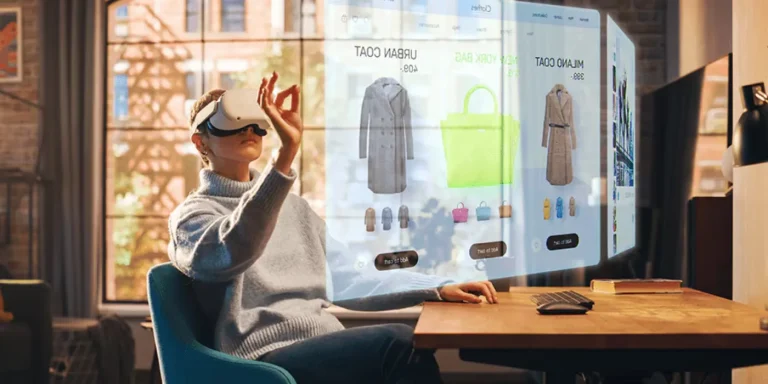
In recent years, augmented reality (AR) has emerged as one of the most revolutionary and promising technologies across multiple sectors, standing out especially in retail. This augmented reality technology, which consists of overlaying information and digital elements onto the physical environment in real time, is profoundly transforming the way consumers interact with brands and products.
Far from being a mere technological novelty, augmented reality is beginning to redefine the entire shopping process, creating immersive, personalized, and efficient experiences both in physical stores and on digital platforms. In this article by MoodWebs, we will explore in detail how augmented reality is reshaping retail, its main applications, success stories across various sectors, the tangible benefits for consumers and brands, the challenges of its implementation, and finally, the future outlook that promises to continue revolutionizing this dynamic and competitive industry.
What is Augmented Reality and Why Is It Relevant to Retail?
Augmented reality is a technology that allows users to visualize, through electronic devices such as smartphones, tablets, or smart glasses, information and digital objects integrated with their real environment. Unlike virtual reality (VR), which completely immerses the user in a digital environment, augmented reality combines the physical with the virtual, enriching the visual and sensory experience without removing the consumer from their real surroundings.
In the retail context, this digital overlay capability of augmented reality opens up a vast range of possibilities to enhance the shopping experience. Customers no longer have to imagine what a piece of furniture would look like in their living room or how a dress would fit them; they can now see it virtually in their space or on their body in real time, with a level of detail and realism that previously could only be achieved through physical trial.
This feature makes augmented reality a strategic tool for retailers who want to differentiate themselves and adapt to the new demands of the digitalized consumer. In a world where the competition to capture customer attention and preference is increasingly fierce, offering unique and practical experiences such as augmented reality has become essential to boost sales and foster customer loyalty.

Enhancing the In-Store Experience with Augmented Reality
Although e-commerce is growing rapidly, the physical store remains a fundamental space for many consumers, especially those who value direct interaction with the product. Augmented reality emerges as a tool that can enhance the experience in these spaces, bringing innovation, efficiency, and personalization.
1. Virtual Try-Ons: Removing Barriers and Increasing Comfort
One of the most effective uses of augmented reality in physical stores is the possibility of virtual try-ons. Traditionally, trying on clothes, makeup, accessories, or footwear requires time and effort, and involves physical contact that may be uncomfortable for some customers. Augmented reality helps solve these issues by offering digital trials that simulate the real effect.
For example, a customer can use an app or a smart mirror in the store that, through the camera, projects the garment or makeup onto their image. Pioneering brands like Sephora have developed augmented reality apps where consumers can visualize different makeup shades on their faces without applying them physically, increasing both confidence and convenience during purchase.
This augmented reality mode not only enhances the consumer experience but also reduces inventory wear from physical testing, streamlines the purchase process, and limits contact in contexts where hygiene is critical. Moreover, the use of augmented reality decreases doubts and increases satisfaction, factors that directly contribute to a reduction in returns.
2. Interactive Displays: A New Way to Get Informed and Decide
Products displayed in stores are often accompanied by tags and signs offering basic information, but with augmented reality, this communication becomes much richer and more dynamic. Using a smartphone or a device provided by the store, the consumer can scan a product and access a wide array of additional content: customer reviews, explanatory videos, usage instructions, comparisons, and related product recommendations.
In this way, augmented reality turns each sales point into a true platform of interactive knowledge, empowering the consumer to make better-informed decisions without relying exclusively on store staff. By offering contextualized and easily accessible information, augmented reality helps shorten the decision-making cycle and increases buyer confidence.
3. Navigation Assistance: Simplifying the Experience in Large Spaces
In department stores or shopping malls, finding specific products can be a frustrating task for customers. Augmented reality applications can guide the user step by step, displaying overlaid visual cues on the screen that lead directly to the desired product or department.
This augmented reality feature not only improves the consumer experience by saving time but also increases the perceived quality of service and encourages additional purchases by making it easier to navigate the store. Additionally, stores can use this AR-guided navigation to display promotions or personalized recommendations based on the customer’s location within the space.
Augmented Reality in E-Commerce: Closing the Gap with the Physical
The growth of e-commerce has led consumers to face its main limitation: the inability to physically interact with the product before purchasing. Augmented reality offers innovative solutions to overcome this gap, integrating elements of the real world into the online experience.
1. Product Visualization in the Customer’s Real Environment
A standout example is the visualization of furniture and decorative items in the buyer’s real space. Applications like IKEA Place allow users to place life-size 3D models inside their homes using a smartphone camera. This experience helps them see how products fit in terms of size, color, and style, reducing the uncertainty usually associated with online purchases of bulky or aesthetic items. This contextual visualization level through AR increases consumer confidence, decreases return rates, and promotes quicker and more satisfying purchase decisions.
2. 3D Virtual Showrooms: Interactive and Dynamic Tours
Another innovative application is 3D virtual showrooms, where customers can explore sales spaces or product samples from anywhere. Through a video game-like interface using AR, users can move around, view products from different angles, and access additional information with a simple click.
These gamified augmented reality experiences particularly attract younger generations, who value interactivity and immersion. Moreover, brands can use these platforms to launch exclusive collections or virtual events that generate greater engagement and traffic.
Sector-Specific Applications of Augmented Reality
The versatility of augmented reality has driven its adoption in multiple retail subsectors, each adapting the technology to its specific needs and characteristics. Below, we review some of the sectors where augmented reality has had the most significant impact.

1. Fashion and Beauty
The fashion and beauty sector has been a pioneer in the adoption of augmented reality due to the visual and sensory nature of its products. The ability to virtually try on clothing, footwear, glasses, or makeup has radically changed the shopping process.
Brands like Gucci have implemented a virtual sneaker try-on feature in their app, allowing users to see how the shoes would look simply by pointing their camera at their feet. Additionally, Gucci has installed smart mirrors in some stores, where customers can try on clothes and accessories without physically changing.
In beauty, Sephora offers its “Virtual Artist” app, which allows users to experiment with thousands of shades and cosmetic products. These tools increase satisfaction and reduce hesitation—critical factors for products that depend so much on visual appeal.
2. Home and Decoration
In this sector, the ability to preview furniture and decorative items is crucial. IKEA has revolutionized furniture shopping with its app that allows customers to virtually place products in any space, evaluating not only the size but also colors and combinations. Other brands use augmented reality to offer interactive tutorials that guide customers through DIY projects, making installation and product usage easier.
3. Sports and Outdoor
Brands like Nike have developed apps that scan users’ feet to recommend the exact shoe size using augmented reality, optimizing the purchase of sports footwear and avoiding returns. Additionally, companies in the outdoor sector allow customers to virtually try out equipment such as backpacks, helmets, or glasses, showing technical details and specific benefits that influence the purchase decision.
4. Automotive
Car manufacturers have also found in augmented reality a valuable tool for marketing. BMW, Audi, and other automakers offer configurators that project full-size vehicles, allow users to explore them from all angles, and customize them with colors, finishes, and accessories. It's even possible to simulate the interior experience, allowing customers to "sit" inside the virtual vehicle before making a decision.
Tangible Benefits of Augmented Reality for Retailers and Consumers
The adoption of augmented reality in retail not only provides experiential benefits but also clear economic and operational advantages. Among the most notable benefits of augmented reality are:
- Increased Conversion and Sales: The ability to virtually try products and visualize details using augmented reality boosts customer confidence, which directly increases the purchase rate.
- Reduction of returns: By decreasing uncertainty and allowing customers to see more clearly what the final product will be like through augmented reality, return rates are significantly reduced, positively impacting logistics and inventory costs.
- Improved Engagement and Loyalty: Augmented reality's immersive experiences create a WOW effect, encouraging customers to spend more time in the store or app and strengthening emotional connections with the brand.
- Inventory Optimization: By reducing the need for physical samples and increasing purchase accuracy through augmented reality, retailers can better manage inventory and reduce losses.
- Valuable Data Collection: Digital interaction with augmented reality provides data on consumer preferences and behaviors, making it easier to create more personalized and effective marketing campaigns.
Challenges in Implementing Augmented Reality
Despite the many benefits, the widespread adoption of augmented reality faces certain obstacles that retailers must consider:
- High Initial Costs: Developing augmented reality apps and devices can require significant investment, especially for small and medium-sized businesses.
- Technical Requirements: The quality of the augmented reality experience depends on advanced devices, good connectivity, and optimized software, which can limit access in certain markets.
- Privacy and Security: Augmented reality often involves collecting personal data to personalize experiences, which raises concerns about data protection and consumer trust.
- Staff Training: Sales and customer service teams need to be trained to handle this technology and assist customers in using it, which may require time and resources.
The Future and Emerging Trends of Augmented Reality in Retail
Looking ahead, augmented reality is expected to continue evolving and solidifying its place in retail thanks to various technological advances:
- Smart Glasses and Wearable Devices: With the emergence of more affordable and comfortable smart glasses, augmented reality will become more naturally integrated into daily life.
- Improvements in Artificial Intelligence: Algorithms will enable more personalized and adaptive augmented reality experiences, anticipating consumer desires and needs.
- Integration with IoT: Connected products and spaces will facilitate dynamic interaction and real-time tracking of user preferences.
- Hybrid AR-VR Experiences: The combination of augmented and virtual reality will open new possibilities for events, promotions, and fully digital stores.

Augmented reality is profoundly transforming retail by offering shopping experiences that combine the best of the physical and digital worlds. From virtually trying on clothes or makeup, to visualizing furniture at home or customizing vehicles in 3D, augmented reality is redefining the consumer journey—making it more interactive, efficient, and satisfying.
Brands that adopt this technology not only gain in competitiveness and sales, but also build stronger and more memorable relationships with their customers. While there are still challenges to overcome, augmented reality is positioned as a key element in the future of retail—a future where technological innovation and human experience converge to create a new shopping paradigm.
If you’re considering incorporating augmented reality into your business, now is the ideal time to plan a strategy that integrates this technology, maximizing its benefits and preparing your company for the next generation of digital consumers. If you want to learn more about the best ways to integrate augmented reality into your commercial operations, write to us at [email protected]. We have a team of experts in digital marketing and augmented reality ready to assist you.
 EN
EN  ES
ES