
For years, third-party cookies have played a fundamental role in digital advertising, web analytics, conversion attribution, and audience creation. These small pieces of information allowed different platforms to recognize a browser when the user browsed different websites, facilitating profile building, campaign measurement, and remarketing. However, the main browsers have introduced increasingly greater restrictions on this technology, driven by concerns about privacy and the need to give users greater control over their data.
This change is forcing companies to rethink the way they collect and use digital information. Although the situation of third-party cookies is not identical across all browsers and Chrome has chosen to maintain a model based on user preferences rather than eliminating them completely for everyone, the general trend is clear: third-party cookies can no longer be considered a reliable and universal basis for digital measurement. In this scenario, Server-Side Tagging is presented as one of the most relevant architectures for improving data quality, reducing dependence on third-party technologies, and making better use of first-party information.
What is Server-Side Tagging?
Server-Side Tagging, or server-side tagging, consists of moving part of the processing of measurement tags from the user's browser to a server controlled by the company or specifically managed for this purpose. Server-Side Tagging makes it possible to change the traditional tag management model, in which the browser executes different Google Analytics tags, advertising platforms, remarketing tools, and other services, sending information directly to each provider. With a Server-Side Tagging architecture, the browser can first send events to an intermediate server, which subsequently processes and distributes the information to the corresponding destinations.
The difference introduced by Server-Side Tagging is important because it adds a layer of control between the user and external platforms. The server can receive an event, check its structure, apply rules, remove unnecessary information, modify certain parameters, and decide which provider should receive each piece of data. In this way, Server-Side Tagging allows the organization to stop depending exclusively on what happens in the browser and gain greater control over the information that leaves its infrastructure.
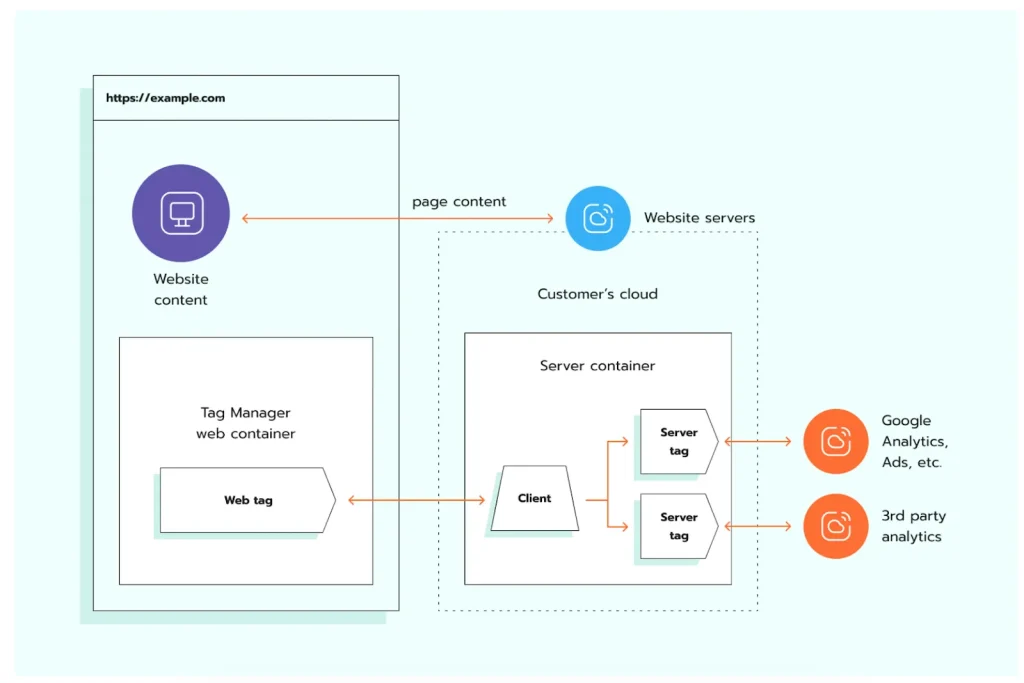
Additionally, Server-Side Tagging does not necessarily eliminate client-side tags nor does it mean that all processing must be carried out on the server. In fact, Server-Side Tagging and client-side tags can coexist and complement each other, especially when certain data needs to be generated in the browser before being sent to the server. The main advantage of Server-Side Tagging is having an additional layer where the processing, filtering, and sending of events can be centralized, facilitating more controlled management of information and integrations with different providers.
Why are third-party cookies losing importance?
Third-party cookies allow a domain different from the site the user visits to store or access information associated with their browser. This capability was very useful for creating advertising and measurement systems across different websites, but it also became one of the main mechanisms associated with cross-site tracking. For this reason, browsers such as Safari and Firefox have implemented very significant restrictions, while other browsers have developed mechanisms to progressively limit certain uses. In this context, Server-Side Tagging emerges as an architecture that makes it possible to rethink how certain measurement data is collected, processed, and sent.
Safari, through its Intelligent Tracking Prevention system, blocks third-party cookies by default and also applies different mechanisms to prevent techniques intended to reconstruct identifiers through first-party storage or similar mechanisms. Firefox also incorporates protections against cross-site tracking. Chrome, for its part, has evolved toward a model in which the user plays a more important role in deciding about third-party cookies, but this does not mean that these cookies will once again constitute a universal and stable technology for all measurement strategies. In this scenario, Server-Side Tagging can help reduce dependence on certain implementations based exclusively on the browser by introducing an intermediate server to manage events.
Therefore, the real change is not simply about waiting for a date when third-party cookies completely disappear. The structural change is that advertisers and platforms can no longer assume that they will have permanent access to a third-party identifier. A modern data strategy must work even when that identifier does not exist, is blocked, or has been removed by the user. Server-Side Tagging is part of this change in approach, as it allows certain measurement operations to be centralized and greater control to be established over data before it is sent to different platforms. In this way, Server-Side Tagging can be integrated into a measurement strategy prepared for an environment in which third-party cookies face increasingly greater limitations.
Server-Side Tagging does not mean recovering third-party cookies
One of the main misconceptions surrounding this technology is thinking that Server-Side Tagging makes it possible to recover the tracking capabilities provided by third-party cookies. This is not correct, since a Server-Side Tagging architecture cannot return to the advertiser information that the browser has decided to block, nor can it legitimately turn a third-party cookie into a universal identification tool. Its objective is to build a more resilient measurement infrastructure using first-party data and collection mechanisms under the company's control.
The server can use a domain associated with the website itself to receive events and, where appropriate, manage first-party cookies through HTTP responses. These cookies can offer additional security features, such as the ability to use the HttpOnly attribute, which prevents certain scripts on the page from reading them directly. However, this does not mean that first-party cookies are unlimited or immune to browser privacy policies, meaning that Server-Side Tagging does not eliminate these restrictions either.
In particular, Safari also applies restrictions to certain forms of first-party storage when it detects behaviors related to tracking. For this reason, the objective should not be to try to create a "supercookie" capable of surviving any privacy mechanism, but rather to build a strategy based on events, first-party data, consent, and legitimate identity when the user provides it. In this sense, Server-Side Tagging should be understood as a control and processing infrastructure, not as a mechanism for circumventing privacy protections.
What information can be recovered?
Server-Side Tagging can help recover part of the information that is lost when client-side tags depend excessively on third-party technologies. One of the main benefits of Server-Side Tagging is improving the continuity of first-party events, since the company can centralize processing and control what information is sent to each platform. This can reduce certain losses caused by implementation errors, content blockers, excessive scripts, or restrictions on third-party connections.
It can also improve data quality because Server-Side Tagging allows information to be normalized before being distributed. A purchase event, for example, can reach the server with a transaction identifier, amount, currency, products purchased, and certain contextual data, and the server can decide which part of that information should be sent to each destination. In this way, an advertising platform does not necessarily have to receive exactly the same data as an internal analytics system or a data warehouse.
Another important aspect of Server-Side Tagging is the connection between digital data and data coming from the backend. Purchases, bookings, registrations, subscription renewals, and other actions that take place in internal systems can be incorporated into a measurement architecture as long as there is an appropriate legal basis. This makes it possible to reduce dependence on what the browser alone can observe and use signals coming directly from the systems that control the commercial operation.
An architecture based on five layers
A professional implementation of Server-Side Tagging can be structured into different layers. The first corresponds to the website or application, where the events necessary to describe user interactions are generated. The second is the consent layer, which determines what information can be processed and for what purpose before the data is sent to specific destinations.

The third layer corresponds to the tagging server, which receives the events and converts them into structured information for processing. The fourth is the transformation logic, where parameters can be validated, fields removed, rules applied, and certain signals generated. Finally, the fifth layer corresponds to the destinations, such as analytics tools, advertising platforms, CRMs, internal systems, or data warehouses.
This architecture allows the company to stop considering each tag as an independent element. Instead, Server-Side Tagging allows the creation of a common data model and the use of the server as a central point from which it is decided what information each provider receives. This is especially important for organizations that work with many providers and need to maintain a consistent privacy and governance policy.
The role of first-party data
The progressive disappearance of third-party cookies increases the strategic value of first-party data. This is information obtained directly from the relationship between a company and its users, such as purchases, registrations, subscriptions, authenticated accounts, forms, loyalty programs, or interactions with products. This data does not depend on a third party being able to recognize the user when they browse different sites.
Server-Side Tagging can act as an infrastructure to make better use of this data. For example, a user can visit an online store anonymously and receive a first-party identifier, subsequently register, and finally make a purchase. When the Server-Side Tagging architecture is correctly designed, certain interactions can be legitimately associated with an account or transaction, making it possible to obtain a more coherent view of the customer journey.
This does not mean that all interactions must be individually identified or that it is necessary to retain information indefinitely. Identification must respond to a specific purpose, use only the necessary data, and respect the user's preferences and rights. The main advantage of first-party data is precisely that it comes from a direct relationship with the organization and can be managed under known rules, while Server-Side Tagging provides an infrastructure for processing it.
Implementation with Google Tag Manager Server-Side
One of the most widely used technologies for implementing Server-Side Tagging is Google Tag Manager Server-Side. In this model, the company creates a server container that can run on cloud infrastructure and configures the site to send events to that container. The server receives requests through clients, interprets the information, and subsequently executes the corresponding tags, triggers, and variables.
The implementation can use Google Cloud or compatible infrastructure, depending on the organization's needs. For production, it is recommended to use a custom domain or subdomain associated with the site, rather than keeping only the default address of the cloud infrastructure. This allows Server-Side Tagging to be better integrated with the first-party ecosystem and facilitates the management of certain cookies and signals.
Once the server has been configured, tags can be created to send information to different destinations. Server-Side Tagging can communicate with external services through HTTP requests, so that a single event reception can feed several systems without the browser having to establish all of those connections individually.
Server-Side Tagging and privacy
Server-Side Tagging can also improve data governance. When all platforms receive information directly from the browser, it becomes more difficult to centrally control what data is being transmitted. A Server-Side Tagging architecture introduces a point where common rules can be established for different providers.
For example, the server can check the consent status before sending an event to an advertising platform. It can also remove parameters that are not necessary for a particular purpose or completely prevent a transmission when the user has not authorized the corresponding processing. This makes Server-Side Tagging a tool that can contribute to technically applying privacy policies.
However, moving data to the server does not eliminate legal obligations. If an activity requires consent, the company must continue obtaining it and respecting the user's decision. Server-Side Tagging should be considered a technological layer within a broader privacy strategy, not a mechanism for avoiding rules concerning cookies, personal data, or advertising.
How to implement Server-Side Tagging step by step?
The first step should be to conduct a complete audit of the current implementation. It is necessary to identify what tags exist, what data they collect, what cookies they use, what providers receive information, and what purposes each processing activity has. Without this audit, there is a risk of moving a disorganized architecture to Server-Side Tagging and maintaining exactly the same problems that already existed in the browser.
The second step consists of defining a proprietary data model. Instead of designing events exclusively with Google Analytics, Meta, TikTok, or another platform in mind, it is advisable to establish a common structure based on the actual needs of the business. Events such as view_item, add_to_cart, begin_checkout, purchase, sign_up, or generate_lead can be used as business concepts that are subsequently adapted to each provider within the Server-Side Tagging architecture.
The third step is to correctly design the consent system. The Server-Side Tagging architecture must know which purposes have been accepted and use that information to decide which events and parameters can be sent. This requires coordinating the consent management system, the web layer, and the server-side container. The fourth step consists of deploying the Server-Side Tagging infrastructure. In the case of a solution based on Google Tag Manager Server-Side, Cloud Run or other compatible infrastructure can be used, in addition to configuring the domain and the conditions required for production. Aspects such as scalability, availability, monitoring, costs, security, and credential management must also be considered.
The fifth step is to progressively migrate the integrations. It is not recommended to remove all client-side tags immediately after activating Server-Side Tagging, because any error could cause a considerable loss of information. A safer strategy is to run both architectures during a testing phase, compare the results, and gradually move the functions to the server.
Measurement of results
The success of a Server-Side Tagging implementation should not be measured simply by the number of events received. A high number of events does not guarantee that the data is correct, useful, or legally appropriate. It is necessary to evaluate the quality of the events, the recorded conversions, and the difference between digital data and actual business results.
One of the most important metrics is the discrepancy between actual sales and the conversions recorded by analytics and advertising tools. It is also relevant to measure the percentage of correctly processed events, transmission errors, latency, server availability, and the proportion of data that continues to be sent directly from the browser to third parties.
From a technical perspective, the reduction in third-party code running in the browser can also be analyzed. Fewer scripts can mean less work for the device, fewer external connections, and a Server-Side Tagging architecture that is easier to control. However, reducing JavaScript should not become the only objective, since a server-side implementation also has infrastructure and maintenance costs that must be included in the evaluation.

The reduction of third-party cookies is forcing companies to deeply rethink their digital measurement and advertising strategies. Server-Side Tagging offers a particularly relevant response because it allows part of the processing to be moved from the browser to infrastructure controlled by the organization, creating an intermediate layer between users and technology providers. This makes it easier to improve data quality, reduce certain third-party scripts, control the distribution of information, and make better use of first-party data.
Its implementation, however, should be approached as a data project and not simply as a technical migration of tags. The company should begin by identifying what information it needs, defining an event model, establishing consent rules, designing the infrastructure, and determining what data each provider should receive. Only after this work has been carried out does it make sense to progressively move the integrations to the Server-Side Tagging environment.
The final objective should not be to artificially recover the tracking model based on third-party cookies, but rather to build measurement prepared for an ecosystem in which privacy plays an increasingly important role. An architecture based on Server-Side Tagging, first-party data, consent, and properly integrated measurement systems can offer greater stability in the face of changes to browsers and platforms. Ultimately, the future of digital measurement will not depend on finding a new cookie to replace the old ones, but on developing an infrastructure capable of generating reliable, useful, and responsible data even in an environment where the user has increasingly greater control over their information.
If your company needs to implement Server-Side Tagging, improve its digital measurement, or design a first-party data strategy adapted to the new privacy conditions, MoodWebs can help you analyze, plan, and implement the right solution. To learn more about our services or request more information, you can write to us at [email protected].
 EN
EN  ES
ES