
Generative artificial intelligence has evolved at an extraordinary pace over the last few years. Models such as ChatGPT, Claude, Gemini, or Copilot are capable of answering questions, generating code, analyzing documents, and helping with increasingly complex tasks. However, for a long time they shared an important limitation: their ability to interact with external tools and systems depended on integrations developed specifically for each application. Every time a developer wanted to connect a language model with a database, an API, a document management system, or an enterprise application, they had to create a custom integration. This approach generated an enormous amount of work, increased maintenance costs, and made many solutions difficult to scale.
Precisely to solve this problem, the Model Context Protocol (MCP) was created: an open protocol that proposes a standardized way for artificial intelligence models to communicate with external tools, services, and information sources. Thanks to this standard, any compatible application can access multiple resources without the need to create a different integration for each one of them. The potential impact of the Model Context Protocol is comparable to that of protocols such as HTTP for the Internet or USB for electronic devices. In both cases, the existence of a standard allowed manufacturers and developers to create products that were compatible with one another without relying on proprietary solutions. The goal of the Model Context Protocol is to do exactly the same thing, but applied to the artificial intelligence ecosystem.
What exactly is the Model Context Protocol?
The Model Context Protocol is an open protocol designed to standardize the way artificial intelligence applications access data, tools, and external services. Instead of building a specific connection for each platform, the Model Context Protocol defines a common language that all parties can understand. In other words, the Model Context Protocol allows a language model to discover what tools are available, understand how to use them, and exchange information with them by following common rules. All of this happens without the model having to know beforehand how each application or service works, since the Model Context Protocol establishes a uniform mechanism for that communication.

A very commonly used analogy in the official documentation is to compare the Model Context Protocol with the USB-C port. Just as a single connector allows computers, phones, hard drives, or monitors to be connected using the same physical standard, the Model Context Protocol provides a common interface for connecting artificial intelligence applications with practically any digital system. This comparison helps to understand that the Model Context Protocol seeks to simplify integrations in the same way that USB-C unified connections between devices. This idea is especially important because the number of tools available for AI continues to grow rapidly, and the Model Context Protocol makes it easier for all of them to interoperate under the same standard.
Without a shared standard such as the Model Context Protocol, each new integration would require developing specific code for each combination of model and service, a problem that increases exponentially as new models and new applications appear. Thanks to the Model Context Protocol, this development effort can be significantly reduced by providing a common and reusable way to connect artificial intelligence models with external services.
Why did the Model Context Protocol emerge?
Before the emergence of the Model Context Protocol, integrations between artificial intelligence models and external applications were highly customized. A developer had to program a specific connection to link a model with Google Drive, another one for GitHub, another for Slack, and another for a corporate database. The absence of a standard such as the Model Context Protocol meant that each new integration required independent development that was difficult to reuse. This scenario created what many experts call the N × M problem. If there are ten AI models and one hundred different applications, potentially one thousand independent integrations would have to be developed to allow all of them to communicate with each other. As the ecosystem grew, the need for a standard such as the Model Context Protocol became increasingly evident and the problem became practically unmanageable.
In addition to the enormous development effort, this situation created other important drawbacks. Each integration used different authentication mechanisms, different data formats, and particular ways of handling errors or access permissions. Maintenance eventually became as complex as the initial implementation itself, since each connection had to be updated separately. The Model Context Protocol appears precisely to break this pattern and provide a unified form of communication between models and applications. Instead of creating hundreds or thousands of independent connections, it is enough for each application to implement the Model Context Protocol once in order to communicate with any other compatible system that also adopts the Model Context Protocol.
How does the Model Context Protocol work?
The operation of the Model Context Protocol follows a client-server model that is quite well known within software development. However, the Model Context Protocol introduces specific concepts adapted to the needs of artificial intelligence models, enabling standardized communication between applications and external tools. When a user makes a request, the application that contains the AI model acts as the host or Host. This Host establishes connections with one or more Model Context Protocol servers using specialized clients that are responsible for managing all communication.
Each Model Context Protocol server exposes certain capabilities. These may include access to documents, execution of tools, database queries, resource retrieval, or any other functionality that may be useful for the artificial intelligence model. What is interesting is that the model does not need to know beforehand how each tool is implemented, since it is enough for the server to describe its capabilities following the Model Context Protocol specifications so that the client can interpret them correctly.
The three main protagonists of the protocol
Although the internal operation of the Model Context Protocol may seem complex, it is actually based on three fundamental components that work together. The first is the Host, which represents the application where the user works and from which all communication begins. It can be a conversational assistant, a development environment, an enterprise application, or any software that incorporates a language model compatible with the Model Context Protocol.
The second element is the Model Context Protocol Client. Its function is to establish communication between the Host and the different servers compatible with the Model Context Protocol. It acts as an intermediary, sending requests, receiving responses, and ensuring that all messages comply with the official Model Context Protocol specification, which guarantees uniform communication between all parties.
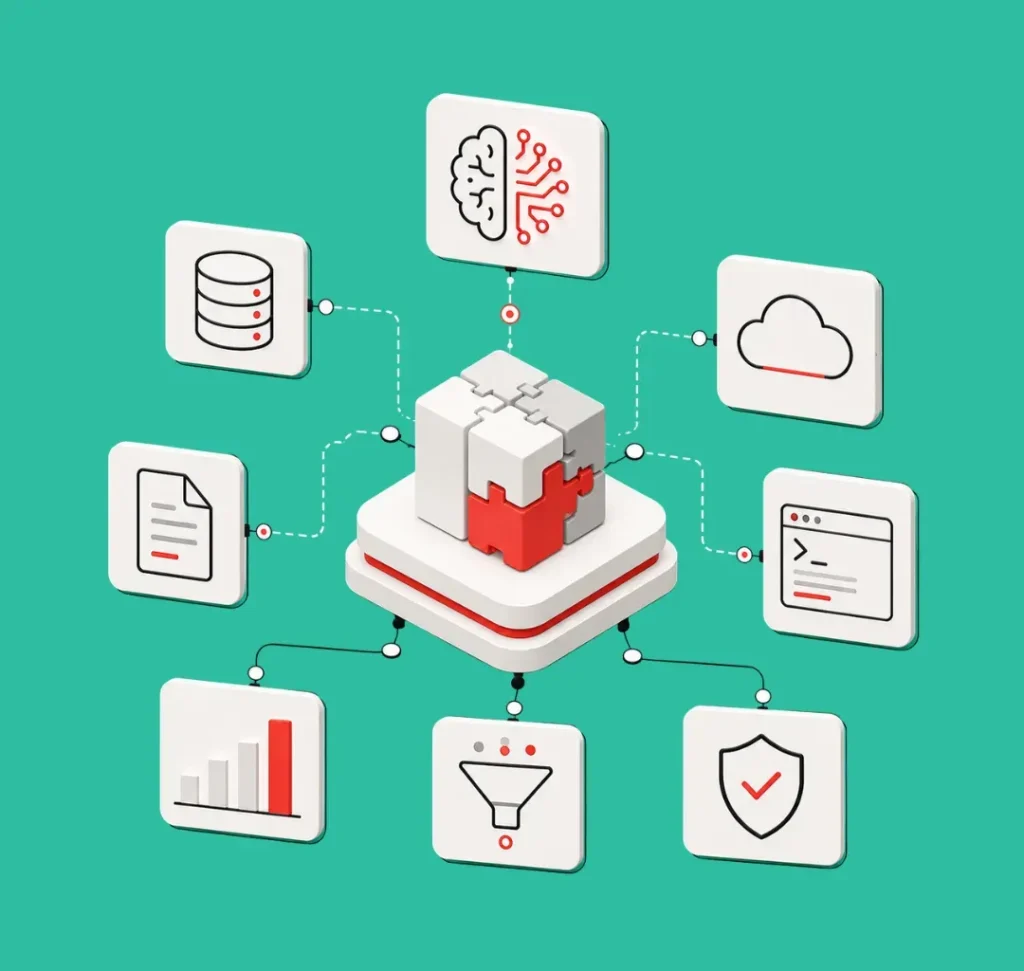
Finally, there are the Model Context Protocol Servers, which expose external tools, resources, and functionalities. A server can represent a database, a file system, a web application, a code repository, or practically any digital service that can provide useful information to the artificial intelligence model. This modular architecture of the Model Context Protocol allows multiple different servers to be connected simultaneously. Thanks to the Model Context Protocol, the same AI assistant can consult locally stored documents, access GitHub, read information from a CRM, and perform searches in databases without changing the way it communicates with each of those systems.
Model Context Protocol Architecture: How do AI models communicate with external tools?
One of the greatest strengths of the Model Context Protocol is that it defines a clear and modular architecture for communication between artificial intelligence applications and external systems. Instead of establishing improvised connections between each service, the Model Context Protocol organizes the exchange of information through well-defined components that perform specific functions. Thanks to this design, any application compatible with the Model Context Protocol can incorporate new capabilities without modifying the main logic of the language model.
This architecture also facilitates the scalability of AI-based solutions. As a company incorporates new applications or services, it is enough to add a new server compatible with the Model Context Protocol so that the intelligent assistant can discover and use it. In this way, the ecosystem grows in an organized manner and considerably reduces the effort required to maintain integrations. The Model Context Protocol defines three main components: the Host, the Model Context Protocol Client, and the Model Context Protocol Server. Although each one fulfills a specific function, they all work together so that the user can interact with multiple tools as if they were all part of a single application.
The Host: the application where the user works
The Host of the Model Context Protocol is the main application from which the user interacts with the artificial intelligence model. It can be a chatbot, an enterprise assistant, an integrated development environment (IDE), an automation platform, or even a custom application created by an organization. Its function within the Model Context Protocol is to manage the conversation with the user and coordinate access to the different available servers compatible with the protocol.
When a person makes a query, the Host of the Model Context Protocol analyzes the request and determines whether it is necessary to rely on external resources to provide a correct answer. If the requested information is not found within the available context of the model, the Host requests the intervention of one or more Model Context Protocol clients to locate the appropriate tools. This entire process occurs transparently for the user, who only perceives an enriched and more accurate response thanks to the connection capability provided by the Model Context Protocol.
In addition to managing the conversation, the Host of the Model Context Protocol is usually responsible for aspects related to authentication, permission configuration, and the management of active connections. This allows for maintaining a clear separation between the user interface and the logic responsible for accessing external resources. Thanks to this separation, applications can take advantage of the benefits of the Model Context Protocol while maintaining a more organized and secure architecture.
The MCP Client: The communication intermediary
The Model Context Protocol Client acts as a specialized intermediary between the Host and the different servers compatible with the protocol. Its main mission within the Model Context Protocol is to establish the connection, send requests, receive responses, and ensure that all messages comply with the official protocol specification. Thanks to this component, the Host does not need to know the internal details of each server compatible with the Model Context Protocol.
Each connection with a Model Context Protocol server uses its own independent client, which allows communications to remain isolated and improves the security of the system. If one of the servers becomes unavailable or experiences an error, the rest of the connections can continue operating without affecting the rest of the application. This design of the Model Context Protocol also facilitates the incorporation of new services without altering the existing infrastructure.
The Model Context Protocol Client interprets the information provided by the servers and presents it to the language model in an understandable format. In this way, the artificial intelligence can decide when to use a tool, what parameters to send, and how to subsequently integrate the results into the final response. This function makes the client a fundamental component for the Model Context Protocol to connect AI models with different sources of information and external capabilities.
The resources of the Model Context Protocol: Providing context to the model
One of the most important concepts within the Model Context Protocol is that of Resource or resource. The resources of the Model Context Protocol represent information that the model can consult during a conversation in order to better understand a situation or respond with greater accuracy. Unlike tools, resources do not execute actions; instead, they provide data that expands the context available to the artificial intelligence.
A resource within the Model Context Protocol can be a PDF file, a text document, a technical manual, a record stored in a database, or even the complete contents of a folder. When the model needs to expand its context, it requests the corresponding resource through the Model Context Protocol and uses that information to generate a much more well-founded response. This approach reduces the need to include large amounts of text within the initial prompt itself.
Thanks to the resources of the Model Context Protocol, applications can work with information that is always up to date. Instead of retraining the model every time a document changes, it is enough to keep the corresponding resource updated so that the artificial intelligence can consult the most recent version whenever necessary. This capability makes the Model Context Protocol an especially useful solution for companies that need their AI assistants to work with dynamic and updated information.
What advantages does the Model Context Protocol offer?
The adoption of the Model Context Protocol provides benefits both for developers and for organizations that incorporate artificial intelligence into their processes. One of the main advantages of the Model Context Protocol is interoperability, since the same standard allows applications from different manufacturers to be connected without developing independent integrations for each service. This reduces implementation time, facilitates the maintenance of complex systems, and simplifies the creation of artificial intelligence-based solutions.
Another important advantage of the Model Context Protocol is scalability. As a company incorporates new data sources or tools, it only needs to deploy new servers compatible with the protocol to expand the system’s capabilities. The rest of the infrastructure remains practically unchanged, which simplifies the long-term evolution of artificial intelligence applications. In addition, the Model Context Protocol improves software reuse, since a tool developed for one assistant can later be used from another compatible model without significant modifications.
This reusability capability of the Model Context Protocol reduces development costs and encourages the creation of shared ecosystems between different applications. From a security perspective, the Model Context Protocol allows control over which resources and tools are available to each client.
Security in the Model Context Protocol
One of the most important aspects of the Model Context Protocol is that it has been designed to provide controlled access to external tools and resources. Although the Model Context Protocol facilitates communication between artificial intelligence models and applications, it does not eliminate the need to apply authentication, authorization, and monitoring mechanisms. In other words, the Model Context Protocol provides the means of communication, but each implementation must establish which operations are permitted and who can perform them.
In an enterprise environment, for example, it would not make sense for an artificial intelligence assistant to have unrestricted access to all of an organization’s information. For this reason, Model Context Protocol servers can establish specific permissions for each client, restricting access to certain documents, tools, or databases. Additionally, many Model Context Protocol implementations incorporate audit logs to determine what actions the artificial intelligence has performed and when they were executed.
Another relevant aspect of the Model Context Protocol is that it allows human control to be maintained over certain sensitive operations. Before executing an action that involves modifying information, sending data, or making important changes, the application can request prior confirmation from the user. This approach based on the Model Context Protocol reduces the risk of errors and allows artificial intelligence to be used in a much safer way in professional environments, where information protection is a fundamental element.
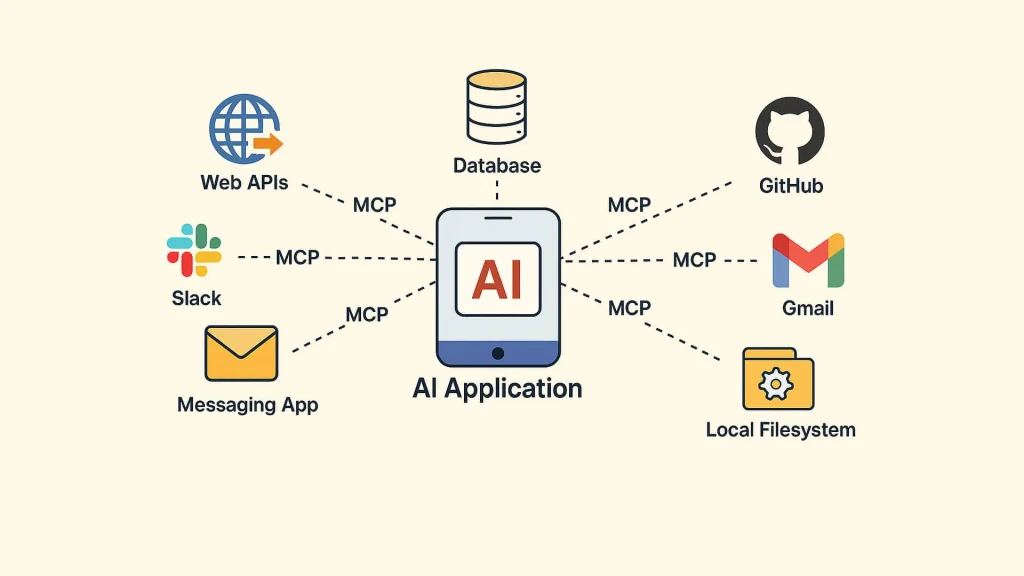
The Model Context Protocol represents one of the most important advances in the evolution of generative artificial intelligence. Its main objective is to provide a common language that allows AI models to access data, tools, and external services in a standardized way, reducing the complexity of integrations and promoting interoperability between applications. Thanks to the open philosophy of the Model Context Protocol, developers and companies can build more flexible, scalable, and easier-to-maintain solutions.
Beyond its technical architecture, the true value of the Model Context Protocol lies in the fact that it expands the practical capabilities of artificial intelligence. A model no longer depends solely on the information on which it was trained, but can consult updated documents, interact with enterprise applications, execute tools, and access real-time data sources. This capability transforms Model Context Protocol-compatible intelligent assistants into much more useful systems for solving real-world problems in areas such as software development, process automation, business management, or advanced information analysis.
Although the Model Context Protocol is still evolving and its adoption continues to grow, everything indicates that it will become a fundamental component of the artificial intelligence ecosystem. In the same way that standards such as HTTP transformed the Internet or USB simplified connections between devices, the Model Context Protocol has the potential to become the standard that unifies communication between AI models and the rest of the digital world. Therefore, understanding how the Model Context Protocol works will become increasingly important for developers, companies, and professionals who wish to make the most of the possibilities of artificial intelligence in the coming years.
At MoodWebs, we help organizations and professionals develop advanced digital solutions, implement strategies based on artificial intelligence, create customized applications, and leverage emerging technologies such as the Model Context Protocol to improve productivity and efficiency. If you would like to learn how to apply artificial intelligence, automation, and new technologies to your business, you can contact the MoodWebs team by writing to [email protected]. Our goal is to help you transform your digital ideas into real solutions adapted to the needs of your company.
 EN
EN  ES
ES