
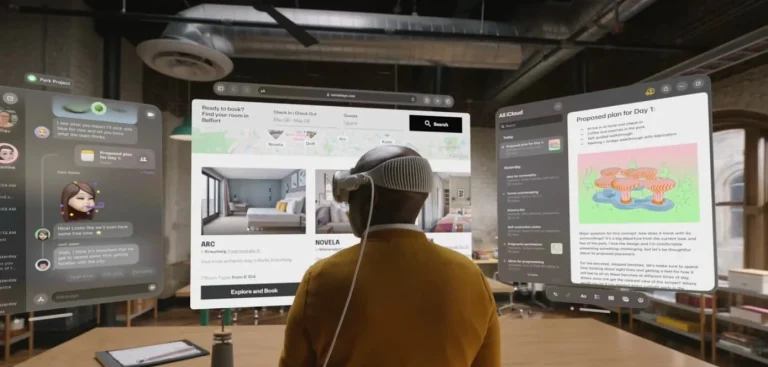
E-commerce has undergone multiple transformations since the emergence of the Internet. First came online stores accessible from desktop computers, followed by mobile applications that allowed people to shop from anywhere, and now a new stage is emerging driven by spatial computing and mixed reality devices. This new paradigm is known as Spatial Commerce and promises to profoundly change the way people interact with products and brands.
The growing adoption of devices such as Apple Vision Pro and Meta Quest 3 is accelerating the evolution of digital experiences toward immersive three-dimensional environments. Unlike traditional screens, these devices make it possible to integrate virtual elements into the user's physical surroundings, creating experiences where products can be viewed, manipulated, and evaluated in a much more natural way. Shopping is no longer an activity confined to a rectangular screen but becomes an experience distributed throughout the space surrounding the consumer.
The concept of Spatial Commerce does not simply involve transferring a web store to a mixed reality headset. Its true potential lies in designing native experiences that take advantage of capabilities such as eye tracking, gesture recognition, environmental understanding, and spatial audio. These features make it possible to create new forms of interaction that were not possible on previous digital platforms.
What is Spatial Commerce?
Spatial Commerce can be defined as the integration of commercial experiences within interactive three-dimensional environments where products and services exist digitally in the user’s physical or virtual space. The concept of Spatial Commerce represents an evolution of traditional e-commerce because it allows the shopping experience to take place within immersive digital spaces rather than being limited to a conventional screen. Instead of viewing photographs or videos on a flat display, consumers can interact with three-dimensional representations of products as if they were actually present in front of them. This approach turns Spatial Commerce into a tool capable of creating a sense of proximity that reduces the distance between physical commerce and digital commerce.

The technological foundation of Spatial Commerce is spatial computing, a discipline that allows devices to understand the environment in which they are located. Through advanced sensors, cameras, and real-time processing systems, devices can identify surfaces, dimensions, obstacles, and movements. These capabilities are essential for the development of Spatial Commerce experiences because they allow digital objects to be integrated coherently into the user's physical space. As a result, products can be virtually placed in real environments and respond naturally to people's actions, reinforcing the potential of Spatial Commerce as a new form of commercial interaction.
One of the main objectives of Spatial Commerce is to eliminate many of the uncertainties that typically accompany online shopping. Through Spatial Commerce experiences, consumers can observe products from any angle, verify their actual dimensions, and analyze how they would fit into their environment before making a purchase.
This capability significantly improves decision-making and reduces the common doubts that arise during the digital purchasing process. Furthermore, Spatial Commerce has particularly important implications for industries such as furniture, home décor, fashion, and automotive, where realistic product visualization can directly influence purchase intent. As technology advances, Spatial Commerce will continue expanding the possibilities for personalization, immersion, and trust within digital commerce.
The Evolution from Augmented Reality to Spatial Computing
Over the last decade, many companies began experimenting with augmented reality applications to facilitate digital shopping, laying some of the foundations that would later evolve into Spatial Commerce. Some retailers allowed customers to visualize furniture in a room using a smartphone camera, while certain cosmetics brands developed systems for virtually trying on makeup. Although these solutions represented significant advances, they were still limited by screen size and the need to constantly hold the device. Despite these limitations, these early initiatives demonstrated the potential of Spatial Commerce to transform the relationship between consumers and products within increasingly immersive digital environments.
The arrival of mixed reality headsets has significantly expanded the possibilities of Spatial Commerce. Instead of using a small digital window, users can employ their entire environment as an interactive surface, a feature that constitutes one of the fundamental pillars of modern Spatial Commerce. Products can appear on tables, walls, or floors while maintaining realistic scale and stable positioning within the space. Thanks to these capabilities, Spatial Commerce enables much more natural experiences in which digital objects integrate seamlessly with the physical world.
This shift implies a profound transformation in the way commercial experiences are designed within the Spatial Commerce ecosystem. Interfaces are no longer organized solely through menus and buttons but through spatial elements that take advantage of human three-dimensional perception. In the context of Spatial Commerce, space ceases to be merely the setting of the experience and becomes a fundamental part of the interface itself. This evolution forces designers and developers to completely rethink how they present products, services, and commercial information.
Apple Vision Pro as a Driver of Spatial Commerce
Apple Vision Pro has been regarded by many analysts as one of the devices capable of accelerating the mass adoption of Spatial Commerce and spatial computing. Apple's strategy is not simply to offer an advanced headset but to introduce a new form of interaction in which applications are integrated with the user’s physical environment. This philosophy has led the company to define its proposal as a new computing category centered on spatial computing, a technology that could significantly boost the growth of Spatial Commerce in the coming years.
One of the device's most innovative features is its interaction system based on gaze, gestures, and voice. Users can select elements simply by looking at them and perform actions through natural hand movements. This form of interaction eliminates many of the barriers associated with traditional controls and creates a more intuitive experience. Within the realm of Spatial Commerce, these capabilities allow interaction with digital products to become much more fluid and closer to the experience of manipulating real objects.
Several international brands have already begun developing applications specifically designed for Vision Pro with the goal of taking advantage of the opportunities offered by Spatial Commerce. Rather than simply reproducing traditional catalogs, these experiences seek to use three-dimensional space to create immersive environments where consumers can discover products in a more emotional and participatory manner. The shopping experience thus becomes a combination of exploration, entertainment, and personalization. This approach demonstrates how Spatial Commerce can evolve beyond traditional e-commerce to offer entirely new experiences.
Meta Quest and the Expansion of Mixed Reality
While Apple has adopted a premium strategy focused on advanced spatial computing, Meta has spent years working toward the democratization of virtual reality and mixed reality, two technologies closely linked to the development of Spatial Commerce. Meta Quest devices have progressively evolved from fully virtual experiences to systems capable of combining digital elements with the user’s physical environment. This evolution has helped expand the possibilities for Spatial Commerce adoption among a broader audience.
The incorporation of high-resolution cameras and passthrough technologies has enabled users to see the real world while interacting with virtual objects. This opens new opportunities for Spatial Commerce, as products can be visualized directly within the consumer’s home or workplace. The experience feels much more natural than browsing conventional catalogs and brings Spatial Commerce closer to a shopping experience similar to that of a physical store.
The incorporation of high-resolution cameras and passthrough technologies has enabled users to see the real world while interacting with virtual objects. This opens new opportunities for Spatial Commerce, as products can be visualized directly within the consumer’s home or workplace. The experience feels much more natural than browsing conventional catalogs and brings Spatial Commerce closer to a shopping experience similar to that of a physical store.

Design principles for spatial shopping experiences
Designing for Spatial Commerce requires abandoning many of the traditional principles inherited from web and mobile design. The interfaces used in Spatial Commerce are no longer limited to a flat surface but are distributed across a three-dimensional space where position, depth, and context become highly relevant. This forces designers to rethink the organization of information and the forms of interaction in order to create truly native Spatial Commerce experiences. As this technology evolves, design becomes one of the most important factors in ensuring the success of any Spatial Commerce strategy.
One of the fundamental principles of Spatial Commerce is considering space as an active part of the interface. Products can be organized around the user, placed on real surfaces, or appear in themed environments specifically designed to enhance the Spatial Commerce experience. Navigation stops being a linear sequence and becomes an exploratory journey where the user decides what to observe and how to interact. This freedom of movement is one of the characteristics that differentiates Spatial Commerce from traditional e-commerce.
Another essential aspect within Spatial Commerce is the naturalness of interactions. Actions such as looking, pointing, approaching, or manipulating virtual objects take advantage of existing human behaviors, reducing the need for learning. The more intuitive the Spatial Commerce experience is, the greater the acceptance among consumers. For this reason, many companies are investing in user experience research to optimize their Spatial Commerce platforms.
Virtual showrooms and immersive spaces
Virtual showrooms represent one of the most promising applications of Spatial Commerce. Instead of browsing pages full of images and filters, users can move through three-dimensional spaces where products are presented in a contextualized way. This approach makes it possible to recreate part of the emotional experience traditionally associated with physical stores and demonstrates the potential of Spatial Commerce to transform digital shopping.
Brands can design fully customized environments that reflect their visual identity and values within Spatial Commerce strategies. An automotive manufacturer can create a virtual dealership where customers inspect vehicles from every angle, while a fashion brand can build an interactive runway where collections are presented dynamically. These experiences transform shopping into a much more memorable activity and show how Spatial Commerce can combine commerce, entertainment, and technology in a single environment.
In addition to improving product presentation, immersive showrooms allow brands to incorporate narrative and emotional elements that strengthen the connection with consumers. Within Spatial Commerce, the environment becomes an extension of the brand and helps differentiate the experience from competitors. As more companies adopt Spatial Commerce solutions, virtual showrooms could become a common alternative to physical stores and conventional e-commerce platforms.
Real-scale product visualization
One of the most valued features of Spatial Commerce is the ability to visualize products at real scale within the user's physical environment. This capability allows consumers to better understand aspects related to size, proportions, and appearance, significantly reducing uncertainty before making a purchase. Realistic visualization is one of the elements that provides the greatest value to Spatial Commerce, especially in categories where dimensions and design are decisive factors.
In industries such as furniture, this advantage is particularly important. Consumers can check whether a sofa fits properly in a room or whether a table occupies too much space before placing an order. This type of visualization reduces the risk of mistakes and improves confidence during the decision-making process. Thanks to Spatial Commerce, buyers can make more informed decisions without needing to visit a physical store.
The same logic can be applied to other industries such as decoration, architecture, or even automotive. The more realistic the digital representation of a product is, the closer the experience becomes to a traditional physical inspection. This simulation capability represents one of the strongest arguments supporting the future growth of Spatial Commerce and its adoption by companies across multiple industries.
Personalization powered by artificial intelligence
The combination of artificial intelligence and spatial computing is creating new opportunities for personalization within Spatial Commerce. Systems can analyze preferences, behaviors, and environmental context to dynamically adapt product presentation. This allows companies to offer more relevant recommendations and improve user satisfaction, making Spatial Commerce a much more individualized experience than conventional e-commerce.
In a Spatial Commerce environment, personalization goes beyond showing suggested products on a list. The system can reorganize an entire showroom, highlight specific items, or modify the arrangement of the space according to consumer interests. Each Spatial Commerce experience can become a unique environment designed specifically for a particular person, increasing the chances of conversion and customer loyalty.
Artificial intelligence can also play the role of a virtual assistant within Spatial Commerce. Through natural conversations, users can request recommendations, resolve questions, or receive personalized guidance without having to navigate complex menus. The integration between AI and Spatial Commerce promises to redefine the digital shopping experience in the coming years, offering levels of interaction and personalization that until recently seemed impossible.

Spatial Commerce represents one of the most significant transformations in the recent history of digital commerce. Thanks to the combination of mixed reality, spatial computing, and artificial intelligence, shopping experiences within Spatial Commerce are evolving from simple two-dimensional interfaces into three-dimensional environments capable of integrating with people's physical spaces. This evolution is profoundly changing the way consumers discover, evaluate, and purchase products, establishing Spatial Commerce as one of the technological trends with the greatest potential to redefine e-commerce in the coming years.
Devices such as Apple Vision Pro and Meta Quest are playing a fundamental role in the expansion of Spatial Commerce. Their technological capabilities allow companies to create native Spatial Commerce experiences where interaction occurs through sight, gestures, and voice, generating shopping processes that are more natural, intuitive, and immersive. At the same time, these platforms provide new opportunities for brands to develop Spatial Commerce strategies capable of building deeper, more personalized, and more memorable relationships with their customers. As more companies adopt this model, Spatial Commerce could become a common component of the digital shopping experience.
Although there are still challenges related to costs, adoption, privacy, and design, the potential of Spatial Commerce is enormous. The combination of advanced personalization, three-dimensional visualization, artificial intelligence, and immersive experiences points toward a future where shopping will become a much more contextual, interactive activity that is closer to traditional physical experiences. Spatial Commerce is not simply an evolution of e-commerce; it represents the beginning of a new stage in the relationship between technology, consumers, and brands. Everything indicates that the growth of Spatial Commerce will continue accelerating as spatial computing becomes more accessible for businesses and users.
Organizations that begin exploring the opportunities of Spatial Commerce today will be better positioned to compete in an increasingly immersive market focused on advanced digital experiences. The development of mixed reality applications, virtual showrooms, 3D configurators, immersive brand experiences, and solutions based on Spatial Commerce will require specialized knowledge in design, user experience, artificial intelligence, and emerging technologies.
If your company wants to prepare for the future of Spatial Commerce and develop innovative experiences for platforms such as Apple Vision Pro, Meta Quest, and other spatial computing devices, MoodWebs can help. Our team works on advanced digital strategies, immersive experiences, application development, and technological solutions adapted to the new trends in the market. To learn more about our services or explore the opportunities that Spatial Commerce can offer your business, you can contact us at If your company wants to prepare for the future of Spatial Commerce and develop innovative experiences for platforms such as Apple Vision Pro, Meta Quest, and other spatial computing devices, MoodWebs can help. Our team works on advanced digital strategies, immersive experiences, application development, and technological solutions adapted to the new trends in the market. To learn more about our services or explore the opportunities that Spatial Commerce can offer your business, you can contact us at [email protected].
 EN
EN  ES
ES