
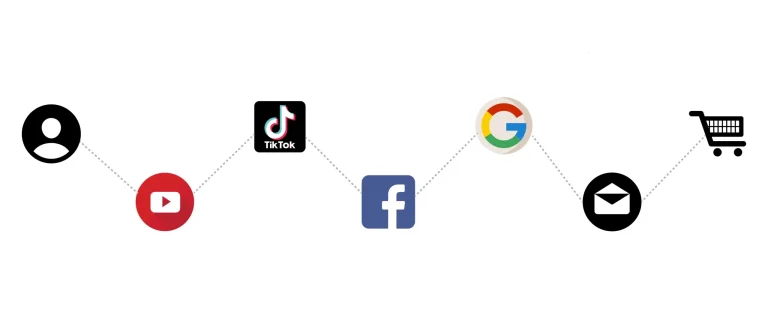
The growth of social commerce has radically changed the way brands sell products and build relationships with consumers. Platforms such as TikTok, Instagram, YouTube, and Pinterest no longer function solely as spaces for entertainment or social interaction; today they are engines of discovery, influence, and commercial conversion. Millions of users discover products daily while consuming short videos, creator-generated content, live streams, or influencer recommendations. However, this new digital ecosystem has brought with it one of the biggest challenges in modern marketing: attribution in social commerce.
The concept of “Social Commerce Attribution” refers to the process of identifying which social channel truly influenced a sale. At first glance, it seems like a simple task, but in practice it has become an extremely complex technical problem. The main reason is that modern consumers rarely follow a linear journey before making a purchase. There is no longer a simple pattern in which a user sees an ad, clicks, and immediately completes a purchase. Today, digital behavior is fragmented, multi-device, and deeply influenced by indirect interactions.
A consumer may discover a brand on TikTok, research reviews on YouTube, save the product on Instagram, discuss it on WhatsApp, and finally complete the purchase days later by directly typing the online store URL. From the perspective of many traditional analytics tools, that sale will appear as direct traffic or organic search, even though the true trigger of purchase intent was a social network.
This phenomenon has caused a silent crisis within digital marketing. Thousands of companies are making budget decisions based on incomplete attribution models. In many cases, social content campaigns that generate an enormous impact on sales are underestimated simply because they do not produce measurable direct clicks.
Why Traditional Attribution No Longer Works Correctly?
For years, digital marketing relied on relatively simple models to measure conversions within Social Commerce Attribution strategies. The most popular was the “last click attribution” model, widely used in Social Commerce Attribution systems, where the entire sale is assigned to the last channel with which the user interacted before purchasing. In an early stage of the internet, this Social Commerce Attribution approach worked reasonably well because purchase journeys were much shorter, linear, and predictable.
However, today’s digital ecosystem is radically different and has completely transformed how Social Commerce Attribution must be understood. Social media has changed consumer behavior to the point of making the classic measurement and attribution systems used for years in digital marketing insufficient. Today, any modern Social Commerce Attribution strategy must consider complex interactions, multi-platform journeys, and purchase decisions influenced by social content that does not always generate direct clicks.

The main problem with the last-click model within the context of Social Commerce Attribution is that it overvalues closing channels and makes discovery channels invisible. For example, a person may discover a product thanks to a viral TikTok video, develop interest over several days, and finally purchase after performing a Google search. From the traditional Social Commerce Attribution perspective, the analytics system will probably attribute the conversion to Google Search, even though TikTok was the true origin of purchase intent and the main trigger of the conversion process.
This creates significant distortions in the interpretation of results and represents one of the greatest current challenges of Social Commerce Attribution. Many companies believe certain social campaigns do not work because they generate few direct conversions, when in reality they are driving a large part of demand indirectly. Precisely for this reason, Social Commerce Attribution has become a central issue for brands, agencies, and advertising platforms that need to understand the real impact of social media on sales.
The situation becomes even more complicated because modern social networks function primarily as influence platforms and not necessarily as immediate traffic channels, something that has completely redefined the Social Commerce Attribution landscape. In particular, content based on discovery algorithms has completely changed the traditional logic of the conversion funnel. Currently, any serious Social Commerce Attribution strategy must consider that many consumers discover products, generate purchase intent, and make decisions influenced by social content without directly clicking on an ad or link.
TikTok and the Birth of Clickless Consumption
The emergence of TikTok marked a before and after in the way users behave on the internet and in how Social Commerce Attribution must be understood. Unlike historical platforms focused on generating traffic toward external websites, TikTok prioritizes staying within the application and the continuous consumption of content. This means that many purchase decisions are born within the platform, but do not necessarily end in an immediate click, something that represents one of the greatest current challenges for Social Commerce Attribution.
The typical behavior of a modern user is much more complex. A person may see a product in a TikTok video, remember the brand name, and search for it later from another device. In terms of traditional analytics and classic Social Commerce Attribution models, TikTok never participated in that sale because there is no traceable click between the video and the final conversion.
Here appears one of the most important concepts in contemporary digital marketing and Social Commerce Attribution: clickless influence. Social media generates brand memory, purchase desire, and social validation even when it does not produce measurable direct traffic.
This phenomenon explains why many brands experience sudden increases in branded searches, direct traffic, or overall sales after viral social media campaigns, even though advertising dashboards and Social Commerce Attribution systems do not reflect clear conversions.
Dark Social: The Black Hole of Digital Attribution
One of the most relevant terms for understanding this problem within Social Commerce Attribution is “Dark Social.” The concept describes all those private or invisible social interactions that traditional analytics tools cannot properly track.
When a person shares a product through WhatsApp, Telegram, Discord, Slack, or Instagram private messages, referral information is usually lost. As a consequence, traffic arrives at the website without clear data about its origin and ends up classified as direct traffic, generating enormous limitations for any Social Commerce Attribution strategy.
This represents one of the greatest technical challenges of modern social commerce and Social Commerce Attribution. A large portion of digital recommendations now occur in private and closed channels. People constantly share products among friends, family members, or small groups, but those interactions are rarely reflected in analytics platforms.
The problem is enormous because current social behavior is based precisely on private recommendations. Many consumers trust a message sent by a friend more than a traditional advertisement. However, those journeys are practically invisible to conventional tracking systems and Social Commerce Attribution models.
The consequence is that social networks usually generate much more commercial impact than official Social Commerce Attribution data appears to show.
The Impact of Privacy and the Disappearance of Cookies
The attribution crisis is not due solely to user behavior. It is also related to the technological and regulatory changes that have redefined the internet in recent years and that have deeply affected Social Commerce Attribution.
The implementation of stricter privacy policies greatly weakened the tracking capabilities of advertising platforms. Apple’s App Tracking Transparency update, introduced in iOS 14.5, allowed millions of users to block tracking between applications. This drastically reduced the ability of platforms such as Meta to connect advertising impressions with later conversions, making the work of Social Commerce Attribution systems even more complicated.
At the same time, browsers such as Safari and Firefox began limiting third-party cookies, while Google announced similar changes for Chrome. Regulations such as GDPR in Europe and other privacy laws also forced a reduction in the level of permitted individual tracking, completely transforming the Social Commerce Attribution landscape.

All of this caused the partial collapse of the classic digital attribution model. For years, marketing depended on identifying users persistently across platforms and devices. Today, that capability is much more limited, forcing brands and advertisers to rethink the Social Commerce Attribution strategies they use.
As a result, companies must operate in an environment where much of the information is incomplete, fragmented, or probabilistic, a reality that has turned Social Commerce Attribution into one of the most complex topics in modern digital marketing.
The Modern Customer Journey Is No Longer Linear
One of the most common mistakes in marketing is imagining that consumers make decisions in an orderly and rational way. Reality is very different. The modern customer journey is chaotic, dynamic, and multi-platform, something that has enormously complicated any Social Commerce Attribution strategy.
The same user may discover a product on Instagram from a mobile phone, research reviews on YouTube from a laptop, receive recommendations on WhatsApp, and complete the purchase days later using a completely different device. This type of journey represents one of the main challenges of modern Social Commerce Attribution.
Each of these steps generates fragments of scattered information. Analytics tools and Social Commerce Attribution systems attempt to reconstruct the journey, but many times they only observe a small part of the real process.
In addition, human decisions do not depend solely on direct interactions. Factors such as brand familiarity, visual repetition, social trust, and cultural validation play a fundamental role. Social media is extremely effective precisely because it works through these psychological mechanisms, although much of that influence is difficult to measure through traditional Social Commerce Attribution models.
The problem is that most attribution systems were designed to measure concrete actions, not accumulated influence, which has turned Social Commerce Attribution into one of the greatest technical challenges in current digital marketing.
Influencer Marketing and Attribution: A Difficult Relationship to Measure
Influencer marketing is probably one of the sectors most affected by this attribution crisis and by the current limitations of Social Commerce Attribution. Content creators generate awareness, conversation, and credibility, but many times they do not produce immediately traceable conversions.
A user may repeatedly see influencer recommendations for weeks before deciding to buy. When the conversion finally happens, the analytics or Social Commerce Attribution system may attribute the sale to an organic search or a retargeting campaign.
This has led many brands to underestimate the true economic impact of digital creators and influencer marketing within Social Commerce Attribution strategies.
The situation is even more complex because social content frequently functions as an emotional accelerator. Influencers do not only show products; they also build cultural context, social validation, and aspirational perception. All of these factors directly influence purchase decisions, even though they do not generate measurable clicks or conversions easily identifiable by Social Commerce Attribution tools.
For this reason, many companies are abandoning the obsession with measuring only direct conversions and are beginning to analyze broader indicators related to Social Commerce Attribution, such as branded search growth, increased direct traffic, or rising social mentions.
Marketing Mix Modeling: The Return of Statistical Models
Given the limitations of traditional tracking and classic Social Commerce Attribution models, many companies are bringing back broader measurement methodologies. One of the most important is Marketing Mix Modeling or MMM.
This approach uses statistical models to analyze how different channels affect overall business growth. Instead of trying to track each user individually, MMM studies aggregated behavior patterns, becoming an increasingly relevant alternative for modern Social Commerce Attribution.
For example, if a brand increases investment in TikTok while branded searches, direct traffic, and overall sales simultaneously grow, the model can infer that there is a causal relationship between both phenomena, even when traditional Social Commerce Attribution platforms do not register enough direct clicks.
The advantage of MMM is that it works better in an environment where cookies lose effectiveness and individual tracking becomes less precise. Instead of depending on perfect data, it works through business correlations and trends, something especially useful for advanced Social Commerce Attribution strategies.
Although it does not offer absolute accuracy, many experts consider this approach much more compatible with the reality of modern social commerce and the new challenges of Social Commerce Attribution.
First-Party Data and Server-Side Tracking
Another important trend within Social Commerce Attribution is the strengthening of first-party data. Brands are trying to depend less on external platforms and build their own data collection systems to improve the accuracy of Social Commerce Attribution in an environment where cookies and traditional tracking are losing effectiveness.
Server-side tracking allows part of the analytical processing to be moved to proprietary servers, improving the quality of certain signals and reducing dependence on third-party cookies. This technology has become an increasingly relevant tool for modern Social Commerce Attribution strategies, especially in digital ecosystems affected by privacy restrictions.
However, even these solutions have limitations. No technical system can fully capture private recommendations, offline conversations, or the emotional influence generated by social content, factors that represent some of the biggest current challenges of Social Commerce Attribution.
For this reason, the future of Social Commerce Attribution will probably not be based on a single technology, but rather on the combination of multiple complementary methodologies capable of better interpreting the real influence of social media on purchase decisions.

Social Commerce Attribution will continue to be one of the greatest challenges in digital marketing over the coming years. As social platforms evolve into ecosystems focused on discovery, influence, and algorithmic content, companies will need to completely rethink their traditional measurement models. The old paradigm based solely on direct clicks is no longer enough to understand how social media truly impacts purchasing decisions.
The future of Social Commerce Attribution points toward hybrid systems where probabilistic models, artificial intelligence, first-party data, Marketing Mix Modeling, incrementality studies, qualitative analysis, post-purchase surveys, and aggregated behavioral signals will coexist. All these methodologies will make it possible to build a much more complete vision of the modern customer journey, especially in an environment where consumer behavior is increasingly fragmented, multi-platform, and difficult to track through conventional methods.
In this new scenario, the historical obsession with finding perfect attribution will probably disappear. The goal will no longer be to identify every individual conversion with mathematical precision, but rather to understand how different channels contribute to overall business growth and how social media generates influence even when it does not produce traceable clicks. That is precisely where the true complexity of modern Social Commerce Attribution lies.
Brands that manage to understand the indirect influence of social media will have a significant competitive advantage. In today’s social commerce environment, many of the most valuable sales are born in spaces where traditional dashboards are incapable of looking: private recommendations, viral content, digital communities, influencers, and social conversations that silently influence the final purchase decision.
Si tu empresa busca optimizar sus estrategias de medición digital, mejorar sus modelos de Social Commerce Attribution y adaptarse a los nuevos desafíos del marketing basado en datos, el equipo de MoodWebs puede ayudarte a implementar soluciones tecnológicas avanzadas, estrategias de analítica moderna y metodologías de atribución adaptadas al entorno digital actual. Para más información sobre servicios especializados, puedes escribir a [email protected].
 EN
EN  ES
ES