
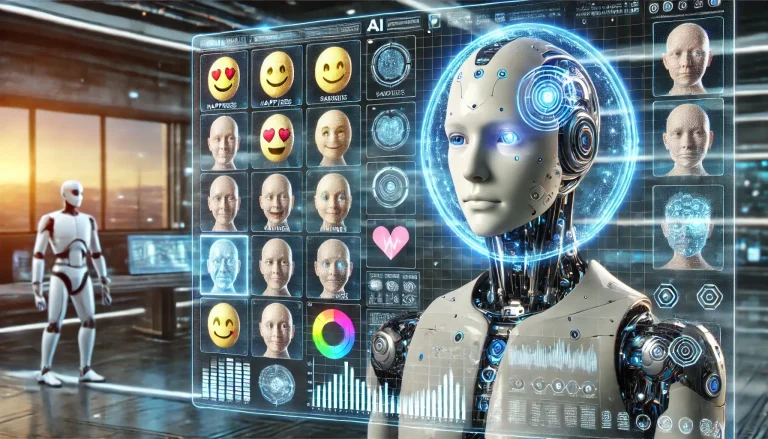
Emotional AI has become one of the most influential concepts in the recent evolution of artificial intelligence applied to digital marketing. In an information-saturated environment, where every brand competes for seconds of attention, emotional AI represents an unprecedented strategic advantage. The possibility of adapting ads in real time according to the user’s mood has ceased to be a futuristic hypothesis and has become an active line of technological and commercial innovation.
For years, advertising personalization relied on demographic and behavioral data. However, emotional AI introduces a radically different dimension: the affective dimension. Instead of limiting itself to knowing what a person buys or which pages they visit, emotional AI seeks to understand how they feel at a specific moment. This transition marks a profound shift in the logic of digital marketing, because emotional AI turns emotion into an operational data point.
The relevance of emotional AI grows in parallel with the expansion of programmatic advertising, large-scale data analytics, and algorithmic automation. Emotional AI does not replace these systems; rather, it enhances them. When emotional AI is integrated with real-time bidding platforms, advertising creativity ceases to be static and becomes a dynamic element that responds to the detected emotional state.
Speaking about emotional AI today implies discussing affective computing, deep learning, consumer neuroscience, and digital ethics. Emotional AI impacts not only advertising efficiency, but also user experience and regulatory debates about privacy and emotional manipulation.

Scientific foundations of emotional AI and affective computing
Emotional AI has its roots in affective computing, a discipline formalized by researcher Rosalind Picard at the MIT Media Lab. From its beginnings, the central idea was that machines could improve their interaction with humans if they were able to interpret affective states. Emotional AI developed on that premise, expanding the capabilities of intelligent systems to recognize emotional patterns.
Emotional AI relies on advances in computer vision, natural language processing, and deep neural networks. These technologies allow emotional AI to identify correlations between observable signals and probable emotional states. Emotional AI does not experience emotions, but it can statistically model the probability that a person is experiencing certain feelings.
The development of emotional AI is also related to research in basic psychology, especially theories that classify universal emotions based on facial expressions. Emotional AI takes these theoretical foundations and converts them into computational models trained on large datasets.
The accuracy of emotional AI has improved significantly thanks to deep learning. Convolutional neural networks, for example, allow emotional AI to analyze thousands of points on a face to detect almost imperceptible microexpressions. This capability is essential when emotional AI is used in real-time advertising, where decisions must be made in milliseconds.
How does emotional AI work in real-time advertising adaptation?
The practical implementation of emotional AI in advertising involves a continuous process of capture, analysis, and response. Emotional AI begins by collecting data through multiple sources. Front-facing cameras can provide facial information, microphones can capture voice variations, and biometric sensors can supply physiological data. Companies such as Affectiva were pioneers in the commercial development of emotional AI systems capable of interpreting facial expressions for market research purposes.
Once the data is collected, emotional AI uses models trained on millions of labeled samples. These models assign probabilities to different emotional states. Emotional AI can estimate whether the user shows signs of enthusiasm, boredom, stress, or satisfaction. This calculation is not absolute but probabilistic, yet it is sufficiently accurate for commercial purposes.
The final phase consists of advertising adaptation. Here, emotional AI integrates with programmatic advertising platforms. If emotional AI detects boredom, it can prioritize more visually dynamic ads. If emotional AI identifies stress, it can activate messages oriented toward well-being. If emotional AI perceives enthusiasm, it can display promotions with greater urgency.
All of this process occurs in real time. Emotional AI analyzes, interprets, and responds within milliseconds. The ability of emotional AI to modify advertising creativity in real time constitutes one of its greatest strategic contributions.
Emotional AI and gladvertising: Adaptive advertising in physical spaces
Emotional AI is also applied in physical environments through the concept of Gladvertising. In this model, digital screens equipped with cameras use emotional AI to analyze the facial expressions of passersby and adapt the displayed content.
Emotional AI in gladvertising demonstrates that adaptive advertising is not limited to the online environment. The integration of emotional AI into digital signage expands personalization possibilities in public spaces. Although this application generates debates about privacy, it also highlights the versatility of emotional AI.
Impact of emotional AI on digital marketing strategy
Emotional AI transforms the strategic logic of digital marketing. Instead of segmenting solely by historical data, emotional AI enables segmentation based on present affective state. This means that emotional AI can alter brand narrative in real time.
Emotional AI improves engagement because it connects with the user’s emotional dimension. Various studies in consumer neuroscience indicate that emotions directly influence memory and decision-making. Emotional AI capitalizes on this scientific principle to optimize advertising effectiveness.
Return on investment can also benefit from emotional AI. By adjusting messages according to emotional reaction, emotional AI increases the probability of conversion. In addition, emotional AI reduces exposure to irrelevant ads, improving brand perception.
Emotional AI also opens the door to new metrics. Instead of measuring only clicks or impressions, emotional AI makes it possible to evaluate emotional reactions in real time. This redefines advertising analytics and positions emotional AI as a strategic intelligence tool.

Ethical and Regulatory Challenges of Emotional AI
The growth of emotional AI raises fundamental questions about privacy and manipulation. Emotional AI may involve the processing of biometric data, which is considered sensitive in many jurisdictions. The collection and storage of such data require explicit consent.
Another relevant debate revolves around emotional manipulation. If emotional AI detects vulnerability and adapts ads to maximize conversion in that state, an ethical question arises. Emotional AI must be implemented with transparency and clear boundaries to prevent abuse.
Regulatory frameworks in data protection already affect emotional AI. Regulations that restrict the use of biometric data condition the commercial development of emotional AI. As emotional AI expands, legal oversight will become stricter.
User trust will be decisive for the future of emotional AI. Without transparency, emotional AI could generate social backlash. With proper governance, emotional AI can consolidate itself as a legitimate and responsible tool.
Emotional AI and Neuroscience: The Link Between Emotion and Decision
Emotional artificial intelligence finds strong support in contemporary neuroscience, especially in research demonstrating that human decisions are not purely rational processes. For decades, the idea prevailed that human beings decide based on logical calculations and conscious deliberation; however, neuroscientific studies have shown that, before conscious reasoning intervenes, the brain has already evaluated stimuli from an affective dimension. Emotions are not a subsequent addition to decision-making, but a structural component of it.
One of the most influential contributions in this field is the somatic marker hypothesis proposed by Antonio Damasio, who argues that emotions act as bodily signals that guide decision-making, especially in contexts of uncertainty. From this perspective, structures such as the amygdala and the ventromedial prefrontal cortex participate in the emotional evaluation of situations before detailed rational analysis is activated. This explains why many decisions are experienced as “intuitions”: the brain has previously processed emotional information that guides the choice.
Emotional AI digitizes this scientific understanding. Through sensors, microexpression analysis, voice processing, writing patterns, and biometric data, systems can identify affective indicators and translate them into quantifiable variables. What neuroscience understands as emotional activation, emotional AI converts into structured data that allow the inference of states such as stress, satisfaction, frustration, or enthusiasm.
The combination of emotional AI and machine learning enhances this capability by enabling the modeling of emotional patterns at scale. Algorithms not only detect individual emotions but also identify collective regularities from large volumes of data. For example, in digital consumption environments, systems can correlate emotional responses with purchasing behaviors, dwell time, or interaction levels. In this way, emotion ceases to be an exclusively subjective phenomenon and becomes an analytical input.
Nevertheless, it is important to emphasize that emotional AI does not replace human psychology nor the complexity of affective experience. Rather, it translates certain observable correlates of emotion into actionable data. This translation necessarily involves a reduction: human emotions are dynamic, contextual, and culturally mediated, whereas computational models operate with discrete categories and statistical patterns. Therefore, emotional AI functions as an instrumental approximation, not as a replica of emotional consciousness.
This bridge between neuroscience and technology explains the growing business interest in emotional AI. In areas such as marketing, user experience, digital education, and human resources, understanding how emotions influence decisions makes it possible to design more personalized and effective strategies. If decisions are deeply shaped by affective processes, then the ability to anticipate, interpret, and respond to those processes becomes a competitive advantage.
In summary, the convergence between neuroscience and emotional artificial intelligence redefines the traditional understanding of human rationality. By recognizing that emotion and decision form an integrated system, technology not only automates cognitive processes but also begins to incorporate the affective dimension as a strategic variable. This approach inaugurates a new paradigm in which decision-making is understood as a neuroemotional phenomenon that can be modeled, analyzed, and, to a certain extent, optimized through intelligent systems.
The Future of Emotional AI in Personalized Advertising
The evolution of emotional AI points toward more precise and multimodal systems. Future emotional AI will integrate facial, vocal, and physiological signals with greater coherence. It is also expected that emotional AI will be incorporated into immersive environments such as augmented reality and metaverses.
Another trend will be predictive emotional AI. Instead of reacting to current emotions, emotional AI could anticipate affective changes through predictive models based on historical patterns.
The expansion of emotional AI will also depend on advances in algorithmic explainability. Users will demand to understand how emotional AI makes decisions. Transparency will be an essential component of the sustainable development of emotional AI.

Emotional AI represents a profound transformation in real-time personalized advertising. By integrating affective computing, deep learning, and advertising automation, emotional AI enables ads to be adapted according to the user’s mood with unprecedented precision. It is no longer only about segmenting by age, location, or browsing history, but about understanding dynamic variables such as motivation, attention level, frustration, or enthusiasm at the exact moment of interaction.
Emotional AI redefines personalization because it incorporates the affective dimension as a strategic variable. This implies moving from marketing based on static profiles to an interaction model sensitive to emotional context. However, the success of emotional AI will depend on its ethical, transparent, and regulated implementation. Responsible data management, informed consent, and clarity in algorithm use will be determining factors in generating trust and legitimacy for its widespread adoption. Without these pillars, technological potential could be limited by social and regulatory concerns.
In the contemporary digital economy, where attention is a scarce and highly contested resource, emotional AI positions itself as one of the most powerful tools for meaningfully connecting brands and people. By understanding how emotions influence decision-making, companies can design less intrusive and more relevant advertising experiences, increasing not only conversion rates but also the quality of the relationship with consumers. The question is no longer whether emotional AI will continue to grow, but how it will be integrated into a framework that balances innovation, competitiveness, and digital rights.
Emotional AI is not simply a technological trend. It is a structural reconfiguration of marketing: a convergence between human emotion and algorithmic calculation that will define the next decade of real-time personalized advertising. Organizations that understand this transition and adopt it strategically will be better positioned to lead in increasingly complex and demanding digital environments.
At MoodWebs, we help companies and brands integrate emotional AI in an ethical, effective, and results-oriented way, transforming affective data into intelligent and measurable advertising strategies. If you would like to explore how to implement emotional AI solutions tailored to your organization, you can write to us at [email protected] , and our team will support you in designing a strategy aligned with your objectives and the highest standards of digital responsibility.
 EN
EN  ES
ES