
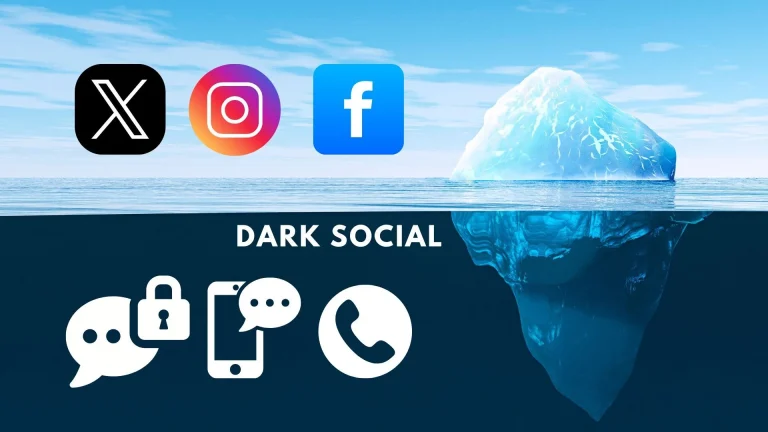
In the era of digital marketing, brands have evolved their tactics to capture attention and generate conversions across multiple platforms. However, there is a phenomenon that challenges a large part of traditional analytics tools: Dark Social.
This term refers to digital interactions that cannot be easily tracked with conventional analytics tools because they occur in private spaces such as messaging applications, emails, closed groups, or direct messages on social networks. Unlike traffic that comes from public social networks or paid campaigns, Dark Social appears in reports as “direct traffic” or without a discernible source, which masks its true impact on conversions.
The relevance of Dark Social is not minor: various studies indicate that a very significant proportion of the content shared by users occurs precisely in these private channels, especially in messaging applications such as WhatsApp, Messenger, Telegram, or via email.
This behavior, although valuable for brands due to the implicit trust it represents, also poses a major challenge: how to measure the conversions that come from these private interactions? Traditionally, many of these actions fall outside the radar of digital analytics platforms, which is why a combination of measurement strategies, tracking techniques, and innovative methodologies is required in order to approach a more complete view of the impact of these hidden interactions.
This MoodWebs article explores in depth what Dark Social is, why it is important for marketing strategies, how the impact on conversions can be approximately measured, and what tactics brands can apply to benefit from these private dynamics.

What is Dark Social and why does it matter?
Concept and origin
Dark Social describes web traffic and social actions that belong to Dark Social and that cannot be tracked by conventional analytics tools nor attributed to a clear source. Dark Social occurs mainly when users share links or content through Dark Social channels such as private messaging, emails, closed chats, or exclusive groups, all of them characteristic of Dark Social.
Unlike links shared publicly on open social networks, Dark Social is characterized by the fact that Dark Social interactions do not leave an evident trace of origin. For this reason, traffic generated by Dark Social often appears incorrectly classified as “direct,” thus hiding the true impact of Dark Social on digital results.
For example, when a user receives an interesting link through WhatsApp or via email—both typical Dark Social channels—and accesses a website, analytics tools usually do not capture the original Dark Social channel. This leads to an underestimation of the real impact of Dark Social, despite the fact that Dark Social significantly influences user behavior and decision-making.
Scale and trends
The available figures on Dark Social are striking and demonstrate the magnitude of Dark Social in the current digital ecosystem. Recent Dark Social studies indicate that around 60% or more of content sharing linked to Dark Social takes place through private messaging applications, which are key Dark Social channels, far surpassing public sharing on open social networks that are not part of Dark Social.
These Dark Social channels, in addition to being preferred within Dark Social for offering greater privacy and trust, are clearly driven by the expansion of Dark Social and by a growing trend among users to interact through Dark Social in closed environments. In these Dark Social spaces, contacts are usually known individuals, which reinforces the credibility of Dark Social and increases the likelihood of conversions, genuine recommendations, and purchasing decisions directly influenced by Dark Social.
Why does Dark Social affect conversion measurement?
Conversion measurement in digital marketing is based on attributing a desired action—such as a purchase, a registration, or a download—to a series of previous events. However, when Dark Social comes into play, this measurement is directly affected, since a large part of the user journey takes place within Dark Social. Traditionally, attribution models consider public interactions, ad clicks, or visits coming from specific campaigns, but they leave out many signals that are intrinsic to Dark Social.
Nevertheless, Dark Social significantly complicates this task because key Dark Social interactions are simply not recorded in analytics tools. Dark Social causes the following:
- The real impact of campaigns that generate strong private sharing through Dark Social is underestimated.
- Conversions are assigned to incorrect channels, such as “direct,” when they actually come from Dark Social.
- Relevant metrics that could reveal the true value of certain content or digital assets influenced by Dark Social are minimized.
For example, a private recommendation from a friend made through Dark Social can generate a purchase. However, from an analytics perspective, the company will only see the final visit as “direct,” without recognizing the decisive role of Dark Social and that prior personal interaction within Dark Social.
Strategies to leverage Dark Social as a conversion channel
Although Dark Social is “invisible” to traditional analytics tools, Dark Social is not impossible to leverage. There are effective strategies to address Dark Social that allow brands to capitalize on Dark Social interactions and design tactics specifically oriented toward Dark Social, encouraging the private sharing inherent to Dark Social and, with it, increasing conversions influenced by Dark Social.
1. Make links shareable and trackable
One of the fundamental tactics to address Dark Social is to incorporate tracking systems that make it possible to partially identify the source of traffic generated by Dark Social, even when content is shared through private Dark Social channels. Some of the most commonly used practices for Dark Social include:
- Adding UTM parameters to links before sharing or publishing them in order to measure the impact of Dark Social. Although these Dark Social parameters are not always preserved when users manually copy links, UTMs facilitate Dark Social measurement when integrated “share” buttons are used.
- Using link shorteners with tracking capabilities to analyze Dark Social, allowing clicks and the origin of Dark Social traffic to be observed as long as these parameters remain intact when shared within Dark Social.
By making shareable links include these Dark Social-oriented tracking tags, brands can more accurately identify whether part of the traffic classified as “direct” actually comes from private actions inherent to Dark Social, thereby improving the understanding and measurement of Dark Social.
2. Integrate messaging-specific social buttons
Placing “Share on WhatsApp,” “Send via Messenger,” or “Send by email” buttons directly within content pieces facilitates sharing through private Dark Social channels. In this way, Dark Social is activated more fluidly, as the user shares within Dark Social without the need to manually copy and paste links, reinforcing the natural dynamics of Dark Social.
These Dark Social-oriented buttons not only increase the likelihood of sharing within Dark Social, but, when tagged with the appropriate Dark Social parameters, they allow visits generated by Dark Social to remain linked to their origin. This improves Dark Social measurement and reduces the erroneous attribution of Dark Social traffic as “direct.”

3. Offer content designed to be recommended
Content that is suitable for being shared on Dark Social is not just any piece of content. In Dark Social, what is most widely distributed is content designed specifically for Dark Social and that offers real perceived value within Dark Social, such as:
- Product recommendations based on personal experiences, highly shared on Dark Social.
- Lists of useful resources that circulate easily on Dark Social.
- Exclusive promotions or benefits designed to be spread on Dark Social.
- Comparisons and success stories that generate trust and are recommended on Dark Social.
People tend to share this type of content through Dark Social because Dark Social adds credibility, closeness, and usefulness within their circle of contacts. In this way, Dark Social is consolidated as a key channel for genuine recommendation and influence among trusted individuals.
4. Referral programs and rewards for sharing
Implementing systems that incentivize private sharing within Dark Social—for example, through unique discount codes or referral points programs designed for Dark Social—encourages users to intentionally share information about the brand through Dark Social with their direct contacts. In this way, Dark Social becomes an active channel for recommendation and growth.
When these systems incorporate unique links designed for Dark Social, it is possible to measure more accurately how many conversions come from users who were privately referred through Dark Social. This makes it possible to make the real impact of Dark Social visible in the generation of sales and business results.
5. Build proprietary private communities
Creating closed groups on WhatsApp, Telegram, or even private forums is a key strategy to strengthen a brand’s Dark Social. These private communities are a direct part of Dark Social and allow brands to exercise closer control over the interactions that take place within Dark Social.
These Dark Social spaces function not only as direct touchpoints with highly engaged audiences within Dark Social, but also as Dark Social channels where recommendations can be transformed into real conversions. Thanks to Dark Social, these conversions tend to occur more easily than in saturated public channels, thus reinforcing the strategic value of Dark Social.
Techniques to measure conversion in Dark Social
Measuring conversions in environments where interactions are inherently private is one of the main challenges of Dark Social. Dark Social makes traditional tracking difficult, but even so, there are methodologies and tools that make it possible to approximate a more reliable estimation of the impact of Dark Social on conversions.
1. Use of UTMs and advanced analysis of “direct” traffic
Adding UTMs is a key practice for analyzing Dark Social, as it helps track the origin of visits even when content is shared through private Dark Social channels, as long as the Dark Social parameters remain intact.
In addition, analyzing traffic classified as “direct” makes it possible to detect patterns that are usually associated with Dark Social, such as:
- Direct visits to deep pages, a behavior typical of Dark Social, and not only to the homepage.
- Traffic spikes not explained by public campaigns or paid strategies, which often indicate Dark Social activity.
This practice does not reveal the exact source of Dark Social, but it allows one to infer the existence of private sharing inherent to Dark Social and its impact on conversions attributable to Dark Social.
2. Self-attribution forms and surveys
Including optional questions in contact or purchase forms aimed at identifying Dark Social, such as “How did you hear about us?”, with options like “Private message” or “Friend recommendation,” allows users themselves to attribute their origin within Dark Social.
Although this Dark Social–related method requires active participation from the user, it provides very valuable qualitative data to understand the real role of Dark Social in the generation of conversions.
3. Advanced attribution models
Traditional attribution methods, such as last click, do not adequately reflect the impact of Dark Social. To properly measure Dark Social, it is advisable to implement probabilistic or hybrid attribution models that integrate Dark Social–related signals, such as interactions across multiple touchpoints. This approach makes it possible to give credit to Dark Social and to prior Dark Social interactions that would otherwise remain invisible in traditional analysis.
4. Qualitative analytics and social listening
Although not all Dark Social interactions can be measured directly, social listening tools help identify trends, mentions, and conversations related to Dark Social, including topics that originate in public channels and then migrate to Dark Social. Combined with quantitative analysis, this approach provides a more complete view of the user journey and the real weight of Dark Social within the digital strategy.
The future of Dark Social and conversion measurement
Dark Social is not going to disappear; on the contrary, it will grow as users increasingly value privacy and intimate conversations over public ones. Brands that integrate this phenomenon into their performance analysis and conversion strategies will gain a competitive advantage over those that ignore it.
The key will be to combine creativity, technology, and analysis to transform the invisible into actionable insights. Increasingly sophisticated analytics tools, artificial intelligence applied to user behavior, and attribution models based on first-party business data will make it possible to close measurement gaps and turn these private channels into real engines of growth.

Dark Social represents one of the greatest challenges and, at the same time, one of the greatest opportunities of Dark Social within modern digital marketing. Dark Social, due to its private nature, makes direct measurement difficult, but Dark Social is not impossible to analyze or quantify when the dynamics of Dark Social are properly understood. Measuring the impact of Dark Social on conversions is feasible if strategies specifically designed for Dark Social are adopted.
Implementing Dark Social–oriented UTMs, designing trackable links for Dark Social, integrating Dark Social messaging buttons, encouraging organic sharing within Dark Social, and using advanced attribution models that take Dark Social into account are fundamental steps to leverage this invisible dimension of Dark Social and turn Dark Social into a strategic asset.
Beyond tools, understanding Dark Social implies recognizing that behind every private Dark Social message there is a recommendation based on trust and credibility. Dark Social relies on close relationships, which makes Dark Social a particularly powerful channel for designing strategies that not only measure but also boost conversions through Dark Social and other intimate channels.
With the right tactics, brands will not only be able to continue measuring the real impact of Dark Social, but also fully leverage Dark Social to generate higher conversions, build deeper relationships with their audiences, and gain a more accurate visibility of their true reach thanks to Dark Social.
If your brand wants to understand, measure, and strategically leverage Dark Social, at MoodWebs we help design and implement advanced solutions to turn Dark Social into real business results. Write to us at [email protected] and discover how we can help you transform Dark Social into a competitive advantage.
 EN
EN  ES
ES