
In an era where mobile devices have become extensions of ourselves, brands that manage to appear at the precise moment and in the right place have a significant competitive advantage. This is where two key concepts emerge: hyperlocal marketing and geofencing, a strategic combination that allows brands to connect with consumers exactly when they are most receptive.
Hyperlocal marketing and geofencing have become essential tools for companies looking to optimize their digital presence in specific areas. Thanks to these techniques, it is possible to run personalized campaigns that are triggered based on the user’s location, increasing message relevance and improving conversion rates.
In this MoodWebs article, we will cover how both approaches—hyperlocal marketing and geofencing—work, what their advantages are, the steps to implement them, and the challenges that must be faced to achieve real results. You will discover why hyperlocal marketing and geofencing are now fundamental pillars of modern digital marketing.
What Do We Mean by Hyperlocal Marketing and Why Does It Matter?
Hyperlocal marketing is based on directing marketing efforts to a very specific geographic area—a neighborhood, a street, a store, or even a building—with the goal of reaching people who are physically nearby and, therefore, more likely to visit your business or service.
Unlike generic advertising aimed at large cities or regions, hyperlocal marketing works because it reduces noise and focuses on those with high “near me” purchase intent. Thanks to hyperlocal marketing, brands can connect directly with consumers who are ready to take action.
Imagine, for example, a restaurant using hyperlocal marketing to promote its daily menu only to those within 500 meters during lunch hours, or a car repair shop leveraging hyperlocal marketing to launch a special offer for those within a 2 km radius seeking immediate service. This precision in hyperlocal marketing allows for greater investment efficiency, less message dispersion, and a closer connection with the consumer.

User behavior reinforces the importance of hyperlocal marketing: many people search using terms like “near me,” “open now,” or “closest store,” and ideally want relevant results instantly. By optimizing your digital presence with hyperlocal marketing strategies and combining it with a strong local SEO approach, you can capture customers who are in the right place at the right time, increasing the chances of conversion.
Another advantage of hyperlocal marketing is personalization. When the message references the user’s surroundings—“Hello neighbor,” “just two blocks away,” “in your neighborhood”—it feels less like a mass campaign and more like a relevant conversation. Relevance within hyperlocal marketing builds trust, improves loyalty, and increases return rates.
Furthermore, for physical businesses (stores, local services, proximity-based businesses), hyperlocal marketing makes obvious sense: why spend on distant audiences who can never visit, when you can invest in those already nearby? This territorial segmentation, combined with proper timing, makes hyperlocal marketing maximize every advertising dollar.
Finally, in a highly competitive local environment where multiple businesses compete for visibility, hyperlocal marketing becomes a differentiating advantage. Appearing first in local search results, receiving good reviews on maps, being visible on mobile devices in your area… all of this contributes to building a strong local reputation thanks to the power of hyperlocal marketing.
What Is Geofencing and How Does It Relate to Hyperlocal Marketing?
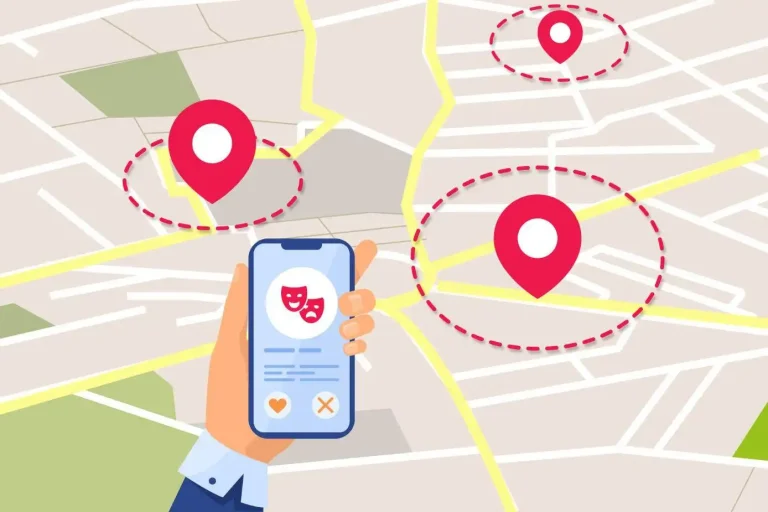
Geofencing is the technological tool that allows a hyperlocal strategy to be executed precisely and efficiently. Essentially, geofencing involves defining a virtual geographic perimeter—a zone delimited by GPS, WiFi, cell data, Bluetooth, or radio frequency—around a physical location (e.g., a store, event, or neighborhood) and triggering a marketing action when the user enters or exits that perimeter.
The way geofencing works is as follows: a company sets the boundaries of the “geofence,” users have a mobile application (or an integration with a supported app) with location services enabled, and when the device enters that perimeter, the geofencing system detects the event and sends a message (push notification, ad, SMS, etc.), an offer, or a call to action.
With geofencing, the brand manages to connect with the customer precisely when they are physically near the point of interest. This use of geofencing turns proximity into opportunity, generating more relevant and effective interactions.
Geofencing allows hyperlocal marketing to move from a strategic concept to technical execution, linking the user’s real location with a personalized and contextual marketing activation. That is why geofencing has become a fundamental pillar within location-based marketing.
By applying geofencing, you can, for example:
- Send an instant coupon to those passing by your store during low-traffic hours using geofencing.
- Show an ad only to those who left a nearby competitor store using geofencing.
- Launch a “today only” offer for those within a 2 km radius during a specific time slot using geofencing.
- Measure how many users entered your store after being impacted by a geofencing notification.
Geofencing, therefore, takes the promise of hyperlocal marketing into measurable, automated, and contextual territory. With geofencing, you not only reach nearby audiences, but you do so in real time, with a message designed for that exact moment, location, and purchase intent. In short, geofencing transforms location into a powerful tool for connecting brands with their consumers.
How Geofencing Works in Practice?
1. Defining the Virtual Perimeter
The first step of geofencing is defining the virtual perimeter. At this stage, the geographic zone where the geofencing system will trigger the action is established. This perimeter can be as small as a street or as large as a neighborhood, defined using GPS coordinates or radii around a specific point.
It is essential that the geofencing perimeter is appropriate for your objective: if it is too broad, the message’s relevance is diluted; if too small, there may not be enough traffic to generate significant impacts. Proper geofencing configuration ensures precision and campaign effectiveness.
2. User Activation
The second step of geofencing involves user activation. For the geofencing system to work, the user must have location enabled and, in many cases, use the brand’s app or an app that supports geofencing services.
When the mobile device enters or exits the defined perimeter, geofencing detects the event in real time. This process is the core of geofencing, as it allows the exact moment a user is near the point of interest to be established and the corresponding action to be enabled.
3. Triggering the Message or Action
The third step in geofencing is triggering the message or action. Once the criterion is met (for example, “the user enters the geofencing perimeter”), a marketing action is automatically triggered.
This action can be a push notification, an SMS message, an in-app offer, or even an ad within another platform connected to the geofencing system. The important thing is that the geofencing message is relevant, contains a clear call to action, and preferably conveys urgency to motivate an immediate response. Thanks to geofencing, brands can impact users at the precise moment, maximizing the effectiveness of every interaction.

4. Measurement and Optimization
One of the greatest advantages of geofencing is its measurement and optimization capability. Unlike other strategies, geofencing allows you to measure results beyond the click: how many people entered the perimeter, how many saw the ad, and how many visited the physical store after receiving a geofencing message.
This data allows you to optimize the geofencing campaign by adjusting variables such as the time, the message, the type of action, or the radius of the perimeter, improving effectiveness over time. In short, geofencing not only enables hyperlocal campaigns but also allows continuous learning and improvement based on real user behavior.
Benefits of Hyperlocal Marketing and Geofencing
Relevance and Personalization
Hyperlocal marketing and geofencing allow your messages to be much more relevant and personalized. By targeting only people within your action zone, the hyperlocal and geofencing marketing message is perceived as close, immediate, and useful. This improves response rates because the recipient understands that the offer “is for them” and “now.” With hyperlocal marketing and geofencing, communication becomes contextual and timely.
Increased Physical Traffic
For businesses that rely on in-person visits—such as stores, restaurants, or local services—hyperlocal marketing and geofencing are powerful tools to attract customers to the point of sale. Thanks to hyperlocal marketing and geofencing, you can encourage immediate visits with real-time offers when the user is nearby. This approach turns location into a direct sales opportunity.
Advertising Investment Efficiency
One of the biggest advantages of hyperlocal marketing and geofencing is advertising investment efficiency. By targeting ads to precise geographic areas, hyperlocal and geofencing campaigns avoid wasting resources on the wrong or too distant audiences. Thus, the cost per relevant impact decreases, and the return on investment improves significantly. With hyperlocal marketing and geofencing, every impression counts.
Local Data and Insights
Hyperlocal marketing and geofencing not only drive immediate results but also generate valuable data on consumer behavior. These strategies allow businesses to better understand local users’ habits, movements, and purchasing patterns, helping refine future campaigns and optimize decision-making. In short, hyperlocal marketing and geofencing transform location data into actionable insights for business growth.
Competitive Advantage
In a world dominated by large brands, hyperlocal marketing and geofencing give local businesses a significant opportunity to stand out. Thanks to hyperlocal marketing and geofencing, businesses can be nearby, visible, and quickly adapt to their environment’s needs. In short, hyperlocal marketing and geofencing turn proximity into a real competitive advantage.
How to Implement a Hyperlocal Marketing and Geofencing Strategy?
1. Define Your Objective and Local Segment
Before starting a hyperlocal marketing and geofencing strategy, clarify what you want to achieve: increase visits, promote a product, attract competitors’ customers, or retain frequent users. Having a clear objective will make your hyperlocal marketing and geofencing campaign more effective.
2. Choose the Right Technology
Select a hyperlocal marketing and geofencing platform that allows you to define perimeters, send messages, and analyze results in real time. The right tool is key for hyperlocal marketing and geofencing to work with precision.
3. Design Relevant Messages
In hyperlocal marketing and geofencing, content must be brief, direct, and actionable. Messages like “You’re 100 meters away, enter now and get 20% off” work very well. Personalization and context are essential in hyperlocal marketing and geofencing.
4. Launch the Campaign and Measure Results
Monitor metrics such as impressions, clicks, visits, and physical conversions. Hyperlocal marketing and geofencing allows you to measure the effectiveness of your actions in real time, making it easier to make data-driven decisions.
5. Optimize and Scale
Test different radii, times, and offers. What works in one area can serve as a model to expand your hyperlocal marketing and geofencing to other locations. Continuous improvement is the foundation of success in hyperlocal marketing and geofencing.
6. Integrate Local with Digital
Don’t limit yourself to notifications: combine hyperlocal marketing and geofencing with local SEO, geolocated social media, reviews, maps, and events in the area. This way, your hyperlocal marketing and geofencing strategy will strengthen both online visibility and physical traffic.
What the Market Shows?
Hyperlocal marketing and geofencing are growing rapidly and transforming how brands connect with consumers. The global hyperlocal marketing and geofencing market is estimated to exceed $25 billion by 2034, with an annual growth rate close to 25%.
Over 60% of location-based mobile campaigns use hyperlocal marketing and geofencing as their main tool, and users reached by hyperlocal marketing and geofencing strategies show significantly higher conversion rates than conventional ads.
All of this demonstrates that hyperlocal marketing and geofencing is not a passing trend but a structural transformation in mobile advertising. It is especially useful for local businesses that want to drive in-person visits, increase sales, and connect with their audience accurately and in real time thanks to the power of hyperlocal marketing and geofencing.

Hyperlocal marketing and geofencing are two sides of the same coin: a comprehensive strategy aimed at reaching the right people at the right time and in the right place. Thanks to hyperlocal marketing and geofencing, brands can connect with their audience in a more direct, precise, and effective way.
While hyperlocal marketing and geofencing provide the strategic approach—understanding the territory, habits, and customer behavior—the technical component of hyperlocal marketing and geofencing offers the ability to act in real time and measure concrete results.
Brands that integrate hyperlocal marketing and geofencing into their strategy can offer personalized, relevant, and timely experiences, generating an authentic connection with local communities and increasing customer loyalty.
The future of hyperlocal marketing and geofencing is not only global or digital, but close, immediate, and human. In a world saturated with messages, the brands that will succeed are those that know how to tell their customer: “I see you, you’re here, and I have something for you right now.”
Do you want to implement an effective hyperlocal marketing and geofencing strategy for your business? Receive personalized guidance with MoodWebs and take your brand to the next level. Write to us at [email protected] , and we’ll help you connect with your customers where it really matters.
 EN
EN  ES
ES