
The world of digital marketing has undergone a radical transformation in recent decades, primarily driven by the exponential growth of the internet, the expansion of social platforms, and the global interconnection of consumers. Today, brands have access to a vast array of digital channels that allow them to connect with their target audience at almost any time and place.
However, despite having powerful tools and more options than ever to reach consumers, one of the greatest challenges facing marketing professionals is the ability to precisely measure the impact of each channel or touchpoint in the buying process. It is in this context that the attribution model plays a crucial role, serving as a fundamental tool in the analysis and optimization of digital marketing strategies.
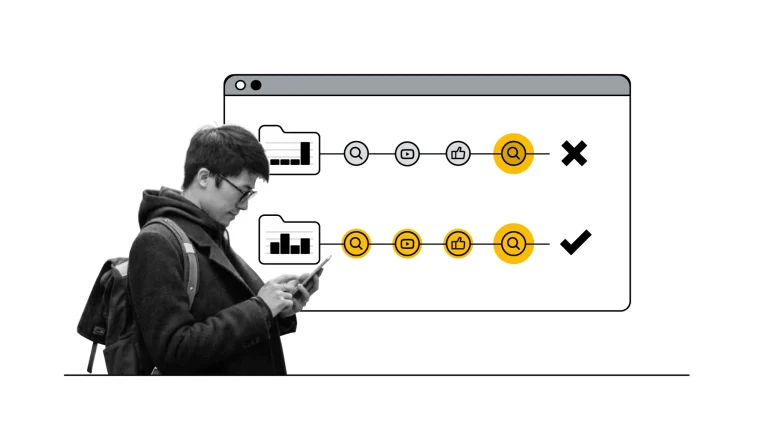
The attribution model allows brands to assign a specific value to each interaction a customer has with the brand, across all stages of the buying journey, from the first contact to the final conversion, whether it be a purchase, a registration, or any other relevant business objective. The attribution process becomes even more crucial when we consider that today’s consumers interact with brands across multiple devices and channels.
A customer might start their journey on social media, then research on search engines, receive a promotional email, and ultimately make the purchase on a completely different device. Without an appropriate attribution system, it would be extremely difficult to identify which touchpoint truly influenced the final purchase decision.
The attribution model not only helps brands understand how different channels contribute to conversion but also facilitates data-driven strategic decision-making, rather than relying on assumptions or intuition. Through this article from MoodWebs, we will delve into what the attribution model is, its importance in digital marketing, its various types, and how to implement them effectively to maximize return on investment (ROI).

What is the Attribution Model and Why is it Crucial for Digital Marketing?
The attribution model is a set of rules that assign value to the interactions a customer has with the brand throughout their buying journey, or customer journey, until conversion occurs. These interactions can include a wide range of touchpoints, such as online ads (on search engines or social media), website visits, email interactions, video content, and even offline interactions such as in-store visits or customer service.
For example, if a customer sees an ad on Facebook, conducts a Google search, visits the brand’s website, and finally receives an email with a promotion, each of these actions plays a critical role in the buying process. The attribution model helps identify which touchpoints should receive credit for influencing the conversion, allowing companies to better understand which marketing activities are working and which need adjustment or improvement.
Attribution becomes even more complex when consumers interact with the brand across multiple devices. A user might browse on their mobile phone, initiate a Google search, and later complete the purchase on their laptop or tablet. In such a context, multichannel attribution models provide a more holistic view of each channel’s impact, regardless of the platform or device where the interaction took place.
Therefore, the attribution model not only brings clarity to how different channels contribute to the final outcome but also gives brands the opportunity to optimize their marketing strategies and allocate their budgets more efficiently, maximizing return on investment (ROI).
Benefits of Using Attribution Models
1. Identification of the Most Effective Channels
In an environment where marketing resources are limited, identifying the most effective channels for generating conversions is essential. Brands today operate in a saturated digital ecosystem, with multiple tactics and platforms available to reach their audience. Some channels, like Google Ads, may be highly effective for generating immediate conversions, while others, such as social media or video content, may have a greater impact on the earlier stages of the buying journey.
Attribution models allow brands to precisely understand how each channel contributes to conversions, enabling informed decisions about where to allocate their marketing budget. For instance, if it is observed that most conversions come from social media ads, a brand may choose to reallocate its marketing budget by increasing its investment in social media while adjusting spending on other platforms that are not yielding the same results, thanks to attribution models.
Moreover, multichannel attribution reveals how channels interact with one another. It is common for a consumer to see an ad on Facebook and later complete the purchase through a Google search or a follow-up email. By understanding how channels work synergistically, brands can optimize their campaigns to maximize the impact of each touchpoint.
2. Understanding the Customer Buying Process
The current buying process is anything but linear. A modern consumer might discover a product or service through an Instagram ad, research it further through a Google search, read reviews on blogs or forums, and finally make the purchase after receiving a promotional email. Each of these touchpoints has an impact on the final decision, but in many cases, brands don’t have a clear view of how all these interactions are interconnected.
The attribution model allows brands to see this entire buying process, helping them better understand how consumers navigate their buying journey. With the information provided by attribution models, brands can adjust their marketing strategies to be present at the right moments and channels along the customer’s journey. For example, if it is discovered that many buyers complete their purchase only after receiving a follow-up email, brands can improve their nurturing strategy to increase the effectiveness of that stage of the journey.
3. More Accurate Measurement of Results
One of the biggest challenges for marketers is measuring the performance of their campaigns and activities. Without an appropriate attribution model, brands may struggle to understand which tactics are truly generating conversions, leading to a waste of resources on ineffective activities.
Attribution models enable precise measurement of the impact of each touchpoint in the buying journey, providing a solid foundation for making informed decisions. For example, if a brand discovers that most of its conversions come from social media interactions, it may choose to increase its investment in these platforms.
Similarly, if channels that are not contributing significantly to conversions are identified, the brand may decide to redistribute its budget to focus on the more effective channels. Implementing attribution models not only helps improve campaign efficiency but also optimizes ROI.
4. Data-Driven Decision-Making
The greatest advantage of attribution models is that they allow brands to make informed decisions based on real data. Traditionally, many companies have relied on intuition or assumptions to allocate their marketing budget. However, attribution models provide accurate information on how each channel is contributing to overall performance. Attribution models allow marketing teams to make adjustments and changes in real time, continuously optimizing campaigns based on the data gathered.
By making decisions based on facts and not on guesses with the help of attribution models, brands can maximize the effectiveness of their marketing strategies. Additionally, data-driven decisions identify opportunities to test new tactics and adjust existing ones, further increasing the chances of generating a higher return on investment.

Types of Attribution Models
There are various types of attribution models, each with a different approach to how credit is assigned to touchpoints. Below are some of the most commonly used attribution models:
1. Last Interaction
This is one of the simplest attribution models. In a last interaction attribution model, all the credit for the conversion is assigned to the last touchpoint the customer had before performing the desired action (e.g., a purchase). For example, if a customer clicks on a Google ad and then completes the purchase, all the credit is assigned to the Google ad.
While it is easy to implement, this attribution model has its limitations as it ignores all previous touchpoints that may have influenced the purchase decision. In many cases, the last touchpoint is not necessarily the most important in the consumer’s decision-making process.
2. First Interaction
This attribution model assigns all the credit to the first touchpoint the customer had with the brand. This attribution model is primarily used when the goal is to measure the effectiveness of acquisition strategies, i.e., those actions designed to attract new customers.
However, this attribution model also has limitations because it does not take into account subsequent interactions that may have had a greater impact on the conversion. Additionally, this model only focuses on the first interaction, overlooking the rest of the customer’s journey.
3. Linear Model
The linear attribution model assigns equal value to each touchpoint in the customer’s buying journey. This model is a way to acknowledge that all interactions have a similar impact on the final decision. The linear attribution model is useful when there is no desire to prioritize one channel or stage of the journey over another.
However, the linear attribution model does not account for the relative importance of each touchpoint, which can lead to misinterpretations in more complex situations where some touchpoints have greater influence than others.
4. Multichannel Attribution Model
The multichannel attribution model is the most comprehensive and advanced. This model takes into account all touchpoints across different platforms (such as social media, paid search, display ads, emails, etc.) and devices before conversion. Through multichannel analysis, brands can see how different channels work together synergistically to drive conversion.
This attribution model is especially useful in today’s multichannel marketing environment, as it provides a more detailed view of the impact each touchpoint has on the entire customer journey.
The implementation of multichannel attribution models is essential for understanding how each touchpoint influences conversions. To do this, proper tracking is required through specialized tools that allow for capturing data from interactions across various channels and devices.
Tools for Tracking
- Google Analytics: Allows for detailed traffic tracking and assigning credits to different touchpoints, with attribution model options that facilitate conversion analysis.
- Adobe Analytics: Offers an advanced view of user behavior and allows the creation of custom attribution models.
- CRM Platforms (such as Salesforce or HubSpot): Enable the tracking of the customer journey from the first touchpoint to conversion, integrating data from online and offline sources.
Use of UTM Parameters
UTM parameters help track specific campaigns, allowing precise segmentation and analysis of each traffic source’s performance. This facilitates the measurement of each campaign’s influence, whether in advertising, social media, or emails, and enables a breakdown of the impact of each interaction in the user’s journey.
Data Integration
Integrating data from multiple channels (both online and offline) is crucial for a complete view of the customer journey. Advanced platforms allow for consolidating information from in-store interactions, call centers, and other touchpoints, improving the accuracy of the analysis.
Continuous Optimization
It is important to constantly monitor and adjust strategies based on attribution data. This enables optimization of campaign performance and maximization of return on investment (ROI) across all channels.

The attribution model is a key tool for any successful digital marketing strategy. An attribution model allows brands to understand the impact of each channel and touchpoint in the customer journey, optimizing resource allocation and maximizing return on investment (ROI). As consumers interact with brands across various devices and platforms, multichannel attribution models become increasingly crucial to providing a complete view of the customer journey.
Implementing an appropriate attribution model not only improves campaign effectiveness but also allows brands to make informed decisions based on real data. This optimizes the customer experience, increases conversions, and strengthens relationships with consumers. Adopting a comprehensive approach to measuring and understanding attribution in digital marketing is undoubtedly a key strategy for any brand looking to stand out in an increasingly competitive environment.
If you want to learn more about marketing strategies that promise to deliver the best results to modernize your business, write to us at [email protected]. With the help of our expert team, we implement multichannel attribution models, among other strategies to optimize your campaigns.
 EN
 ES